Showing posts with label Nine Inch Nails. Show all posts

December 18, 2014

I WILL WRITE A MYSTERY FOR YOU TO SOLVE: An Oral History of Lilys' Astonishing Eccsame The Photon Band

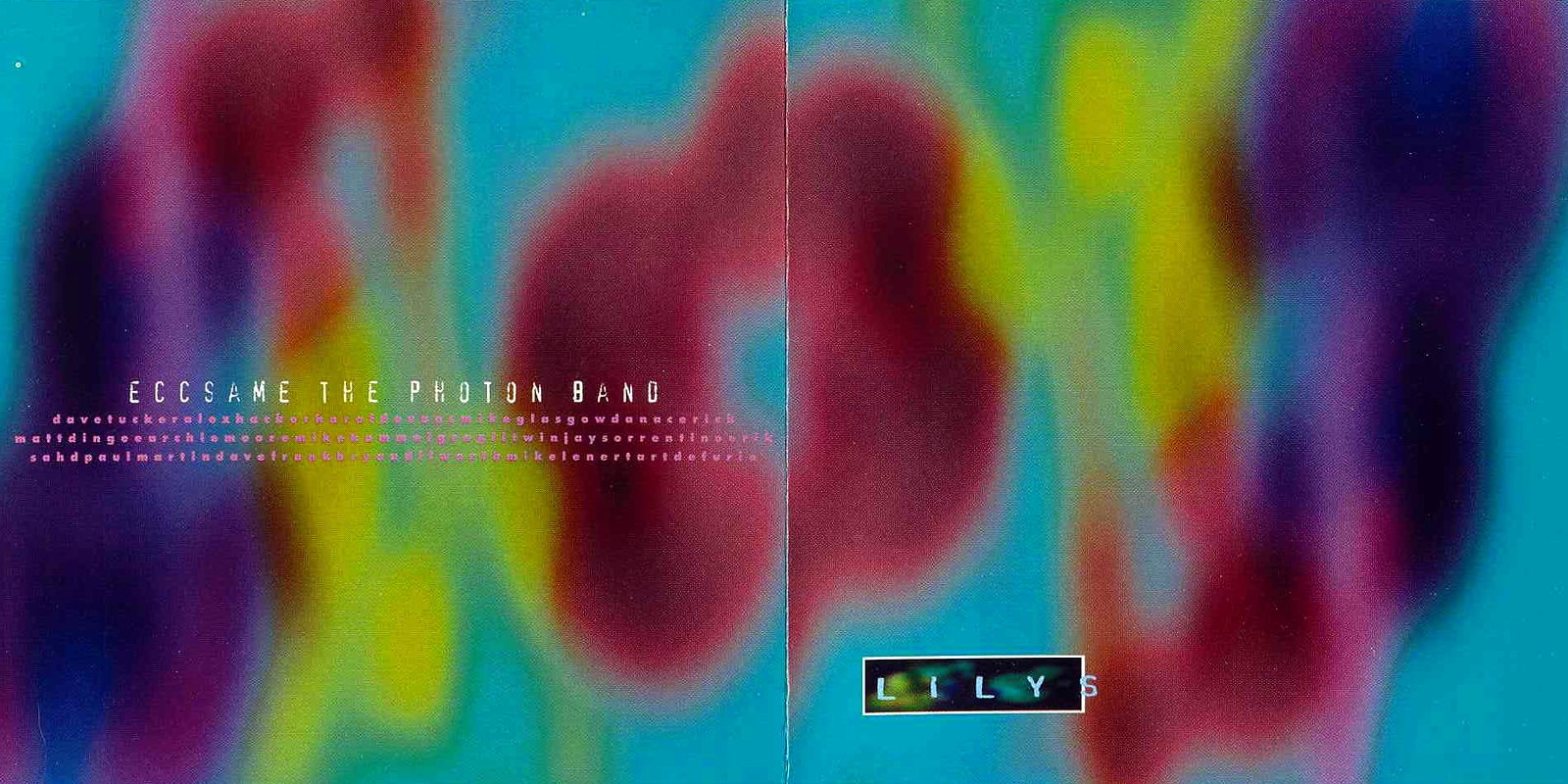
Lilys - Eccsame The Photon Band

|| by EDWARD CHARLTON || [updated] This month marks the 20th anniversary of the release of Lilys' powerful and mysterious Eccsame The Photon Band, a unique collection even among the oeuvre of Kurt Heasley, the band's notably restless songwriter and only constant member. For our money, it is certainly one of the most engaging -- if underheard -- indie rock albums of the '90s. Like a lot of great music, the album's creation owes a debt to that rare and singular cocktail of youth: chance, environment and a positive open-mindedness shared among the four men who created it. "Behold and open to the light," translates the title -- a sentiment that seems to have guided the principals behind it from the foursome's very first minute together.

As we listened to Mr. Heasley, drummer Harry Evans and producer Rich Costey tell the story of the album, we found that Eccsame The Photon Band was a roughly month-long flash of exhaustive inspiration -- a gnawing, melodic, experimental expression that sprang into being so suddenly it felt as if it were over nearly as soon as it had begun. Despite that, the music and production contained therein has continued to resonate with those involved, as well as with a fanatical cult following attracted to its atypical dream-pop charms. Among those, cryptic lyrics, crestfallen textures, occasional moments of loud guitar and a spiritual and devastating silence all continue to stun. To mark the aforementioned anniversary, Clicky Clicky spoke with Mssrs. Heasley, Evans and Costey about the summer of 1994, discussing a wide-range of topics including the philosophies, drum sounds and even the studio weeping that birthed a rare and unique aural document.

"I can't deviate out of the moment -- you get into the game of expectations, then you get into the game of disappointment," Heasley tells Clicky Clicky from his present home in Los Angeles. The sentiment arrives early in our conversation about the album, and it quickly becomes apparent that Eccsame was (and is) something of a mission statement for just that mentality.

The genesis of that notion came two years prior to the creation of Eccsame, spurred by some of the negative reception to Lilys' magnificent and now-legendary 1992 shoegaze debut full-length, In The Presence of Nothing. "I had no idea people would listen to this," he says of that collection, "Much less feel so strongly [about it]. It was ultimately just a group of friends making something in a basement for a few hours. I took it as the most extreme feelings [from some in the scene] of being left out of their own party."

Disappointed, but confident in the power of his on-the-fly approach, Heasley began to see how the band's process might function in the face of more standard and predictable musical norms.

In the wake of the flawless, power-pop injected A Brief History of Amazing Letdowns EP that was released the next year, Heasley made some life changes that would further create the conditions for an experiment like Eccsame. "I had new urban experiences because I had moved from Lancaster [Pennsylvania] into Philadelphia proper, living with some incredible people," he said, "Joey Sweeney let me sleep on his girlfriend's couch for weeks. It was just this ongoing live/work/play space and the amount of literature, cinema and old records that I was being turned on to for the first time was great. There, I had the feeling of going from 22 to 23, and the prevailing wisdom that 23 is the best worst year of your life. Slowly, there were responsibilities creeping in and the realization that 'this is not a dress rehearsal.'"

At the same time, the alternative/grunge zeitgeist of the prior several years was beginning to breed bad vibes. Not only did Kurt Cobain's death in the spring of '94 mark a dramatic shift in the mood of rock culture, but recent records by Talk Talk's Mark Hollis and Pale Saint's Ian Masters alerted Heasley to the loss of fidelity and subtlety in those buzzing times. "Those gated drums in '92," he exclaimed with a sigh. A trip to a Broadway production later that year would also make an impression on him. "Listening to what a five-piece pit orchestra could do literally blew me apart. Working from that level where everyone plays their part and has mastered themselves revealed a new world."

In the winter following the release of A Brief History Of Amazing Letdowns, Heasley began sketching out some fresh ideas. Those recordings would ultimately be released on 2000's Tigerstyle Records split with Aspera Ad Astra. As a historical document, the four songs reveal a remarkably clear vision of the minimal, dreamy sound that would ultimately define Eccsame -- what Stylus Magazine writer Andrew Unterberger described as "Not influenced by shoegazing as a genre, but rather as a principle."

It was time to enter the studio.

That summer, spinART Records agreed to provide five weeks of time at Studio .45, a converted turn-of-the-century Colt firearms factory in Hartford, Connecticut. It was also at that point that Harry Evans of power-pop standouts Poole and producer Rich Costey entered the picture.

Evans had known Heasley for a few years by '94, and had played on every Lilys release beginning with Presence. The two first met due to being physically larger guys in the scene who looked similar and both showed up at the same music store. "I was shopping there and somebody called me (Kurt's nickname) 'Wally' and I was like, 'no, I'm Harry!'" Evan says, laughing, "We happened to be at the store at the same time eventually and recognized each other due to that mix up. We started hanging out and eventually he asked me if I wanted to play drums for him. He played me "February Fourteenth" and I was like 'What the hell! Of course!'"

Following the release of A Brief History and the subsequent shows for that record, Heasley approached him with an idea. "Kurt was like, 'I want to make a record, and I want it to just be you and me.' He booked a lot of time. I hadn't heard any of the material, but he said we could learn it in the studio. Having faith in anything Kurt does, I agreed immediately," Evans reflects. That summer, the two loaded up a van with gear and made the trek to Hartford. There, they met producer Costey and engineer Mike Deming. Costey had been chosen based on work he had done with scene compatriots The Swirlies.

"I was doing a few records for spinART around that time, and at some point I ended up on a phone call with Kurt," Costey remembers, “He was an interesting character on the phone, and I still remember my first phone call with him -- rambling on and on whilst puffing on cigarettes the whole time. We must have connected somewhat. I liked the psychedelic aspect to [Lilys'] music a lot, based only on the album they had out the year before, and given the general monochromatic, conservative landscape of American grunge at that time, Kurt's music struck me as being a total technicolor garden. I had worked with The Swirlies, whom I think he begrudgingly respected, but those two bands were actually quite different in approach. The Swirlies were fighting their own limitations whereas Kurt never saw or felt any limitations at all... [He] was inventing his own landscape."

Setting up on the first day, Heasley and Evans filled out Studio .45's large, single-room with their instruments. Beginning at dusk, the duo at first had a hard time connecting. "On the first day we set everything up, Kurt was going to guide me through the songs," said Evans, "We started recording really late, but it was just not clicking. The first song we were working on was "FBI And Their Toronto Transmitters." Eventually I got super frustrated. While I had told myself initially that I was going to be really sober and work as hard as possible during the session, we ultimately took a break and I got REALLY high. We went back in and nailed it in the first take. I was like, "Aw, this is really disappointing (chuckles)."

"For the first 10 days Costey probably didn't think they were songs!," Heasley added.

After these initial hurdles, the duo settled into a groove, with Evans adapting to Heasley's ideas and advice regarding drumming. "There was a methodical thought to the way that the fills were put together. He really helped me to curb my ego, and I was willing to say 'I will listen to your ideas.' Ultimately, they proved to be great ideas. I had to be open," Evans remembered.

The songs gradually came together over the ensuing weeks, and many of the album's iconic textures began to take focus -- specifically, the massive, roomy drum sound that many Eccsame cultists rave about.

Costey recited the technical details for accomplishing this with aplomb. "The drum sound was a combination of several things: the hard, open space that the live room at Studio .45 presented; a precisely placed AKG 414 placed in between the kick and snare drums, aimed at the floor... heavily compressed with a Spectrasonics 610 compressor; and also the minimal and incredibly powerful, tasteful playing of Harry Evans. Listening to it today, it seems a study in how a drummer should play to the sound presented to him or her, as opposed to the other way around."

Mike Deming is also credited by the other three as being instrumental to the presentation. "I’ve got to credit him for that drum sound. He was a twisted, evil audio genius. He was crazy and so into what he did on a micro level," said Evans, referencing at least obliquely the album's often overwhelming negative space, best heard in the long, faraway intro and subsequent eruption of focus on "The Turtle Which Died Before Knowing."

Other subtle, genius moments were entirely due to chance. On some songs, different takes were mixed together and the resulting edits created things that thrilled everyone in the control room. "A couple of those moments where the vibrato on the guitar shifts patterns -- we couldn't have planned that, but that's the thing! We were open not necessarily to it being correct, but to it being right for what it was," Heasley said.

Other moments betrayed the quieter vibe with sheer power. "The Hermit Crab," "Kodiak (Reprise)" and "Radiotricity" all rock in places, despite being composed mostly with clean, bass string strums. Costey explains that the amping of the guitars went a long way in lending huge power to a quiet source, "One simple thing Kurt was doing with his guitar sounds at the time was to run two different tremolo pedals into two different amps," he said, "It's really simple, of course, but it made for an off-kilter, drunken, gurgling guitar sound that completely shaped the feel of the record."

Elsewhere, such as on the down-tempo lullaby-pop of "Day Of The Monkey," Costey sampled Evans' drums to create a hypnotic loop, later adding room recordings of him playing along to himself to add to the overall sonic fantasia.

The collaborative aspect between the four also played a key role in the shape of the album. "He had done Swirlies records," said Heasley of Costey, "So I was like 'throw me whatever note you think should be in this melody.' I think you can only do so many records where that special and fun ability exists."

As the sessions wrapped up, it was also clear that the process of achieving the album's menthol-cool psychedelia had thoroughly exhausted Heasley. Much of the tracking came down to the wire, and many of his vocal parts had to be recorded at the end in a prolonged series of takes.

"I spent the final 18 hours of tracking in the vocal booth," Heasley recalled, "By the time we were working on "Hubble" I was completely drained by the process, from all these different drives that went into the album. You can hear me crying at one point. I couldn't even stand, I was propped in a chair." Costey, aware of the strain and the reality of the moment, let the tape run. What followed was personal, uncomfortable and brilliant.

It's apparent when Heasley talks about "Hubble" that the song is special to him, referring to it as the closing sequence of the booster of the space shuttle falling to Earth. More importantly, it's a fitting end to the hyper-productive sessions that produced a collection of songs that were not only spacey-sounding, but physically so. Costey took the tapes to Water Studios in Hoboken, New Jersey and Philip Glass' The Looking Glass studio in New York for the rest of the post-production. There, he added many of the synth textures and final mixing details. SpinART had the album out by the end of the year.

And then... it was over.

"Kurt moved to California, I believe, shortly after we made the record," said Evan. "I feel like nobody really got it, understood it or appreciated it when it came out." No shows were played to support the release, which somehow makes the recording all the more mythical.

Within a year, Heasley transformed Lilys into the mod-rock powerhouse that would define the next phase of the group, with songs like "Nanny In Manhattan" (a version of which was recorded during the Eccsame sessions but lost with the master tapes) broadening the exposure of the band and leading to a record deal with Sire. Evans would continue a successful run as the frontman of indie pop savants Poole, an act that also recorded for spinART. Lastly, Costey would use his resume with bands from the East Coast dream-pop and 'gaze scene to begin work in Los Angeles, eventually engineering and producing a seemingly endless list of big-name musical personalities including Sigur Ros, Fiona Apple, Nine Inch Nails, Muse, Foo Fighters and self-professed Swirlies fans Mew, among many others.

Despite the very abrupt end to the Eccsame phase of Lilys, and the scattering of its participants, it is apparent that the three remember the time in the studio fondly, and all have an unshakable faith in the final product.

"I felt pretty good about the album when we had finished it," Costey adds, "It seemed fresh, inventive, and colorful. Kurt's writing isn't miles away from Syd Barrett territory, but as opposed to Syd, Kurt's lyrics were open and personal. I had hoped that it would be recognized a bit more for what I felt was something pretty unique at that time: Psychedelic indie with heavy fuzz, samplers, and 808s -- but it seemed to never really get the attention it deserved. Kurt went straight to The Kinks' Muswell Hillbillies [as the template] for his next album and finally had his talent recognized, but in the process it had always felt to me that Eccsame was just overlooked."

Most importantly though, the sense of trust between the album's principals appears to be the most defining and memorable part of the era. Listening to Evans and Heasley, in particular, speak of their relationship during that time illuminates a connection between kindred souls, a pair determined to create and build as a unit.

"I could never have that kind of naive trust again. You basically get [it] once." Heasley added somberly.

At times during this reflection, it shows that both might harbor some desire to work together again. In the age of '90s dream-pop band reunions, with acts including Slowdive, Medicine, Ride and My Bloody Valentine thrilling audiences once more, it wouldn't be seem that unusual for an influential lineup of Lilys to get back together, hopefully even for new music.

"He knows that I'm willing to work with him anywhere, anytime. At the drop of a hat, I'm in," Evans proclaimed, ever the dedicated bandmate, ignoring the thousands of miles between them.

That possibility is a dream for this blog, at least, and it is dreaming big that brought together those men in 1994 -- hedging their bets on chance and understanding. But big dreams can live on in unusual ways, and funny enough, it is because of the Lilys that this scribe first spoke to this editor at Clicky Clicky some five years ago. And, because of all of that, it has ultimately brought you, dear reader, to what may not yet be the final chapter in the story of a very special and evolving piece of art.

"Behold and open to the light."

Currently, Eccsame The Photon Band is out of print (spinART folded in 2007), and both CD and vinyl copies command steep prices in the collectors' market. Heasley has been negotiating the reissue of In The Presence Of Nothing and two other unspecified titles, and also the release of new music, according to news we reported here in March. Through the murky magic of the Internet, you can listen to selections from Eccsame via the YouTube playlist posted below. -- Edward Charlton


SELECTED PREVIOUS COVERAGE:
In Bloom: Lilys Poised For Massive Resurgence; New Music, Reissues And Live Performances Planned
That Was The Show That Was: Lilys with Prefab Messiahs | Lilypad | 15 June
That Was The Show That Was: Lilys | Lilypad | 25 May
A N D I F O R G O T A L O N G T I M E A G O H O W Y O U F E E L : ten now acts perform selections from the early recordings of Lilys, 1991-1995
20: Lilys | In The Presence Of Nothing
Today's Hotness: Lilys
YouTube Rodeo: Lilys' Amazing "YCJCYAQFTD," "A Nanny In Manhattan," "Baby's A Dealer"
Footage: Lorelei Cover Lilys' "February 14th" | Slumberland 20th Anniversary
Today's Hotness: Lilys
750 Times The Same Song: It's All About The Lilys

December 4, 2013

We're Trapped Inside The Song Where The Nights Are So Long: Clicky Clicky Speaks To Krill's Jonah Furman About Deep Shit Like Divisions Of The Self And The Beast Within

[Images by Jonah Furman and Noah Furman] Time And Relative Dimension In Space is a mouthful of words, which is why it is almost always acronymed, but it has some bearing here, so please indulge the introductory tangent. It's a fictional thing from a teevee series and series of books, the TARDIS is, and on the outside it appears to be a large phone booth (it's not a proper phone booth, but most of our readers are American, so let's just go with "phone booth"). The important thing to know for now is that while this time-traveling, spaceship thingo appears to be the size of a phone booth on the outside, it is (as a result of unspecified extraterrestrial magic/technology) impossibly larger on the inside. Which is a lot like the music of Krill, the Boston-based post-punk trio whose music angularly jangles and thumps while the fronter, the titular Jonah Furman whose name you see above, sings about bugs and fear and loathing and psychological mutineering and negating the self and Dostoevsky -- the harder you listen, the bigger (and deeper) it all gets. Which is, coincidentally, a lot like what we experienced when we cobbled the interview together.

Cards on the table: this was conceived as a bit of a perfunctory exercise. We're friends with the fine people at The Ash Gray Proclamation blog, who are hosting a benefit show this Saturday for Toys For Tots down in Plymouth, MA. So we thought, hey, let's see if we can help promote the cause by running a timely feature with one of the bands. Synergy! Shake your groove thing! Having vibrated heavily to Krill's 2013 LP Lucky Leaves [review here], the choice of who we wanted to interview was easy. However, the incredibly forthright and thoughtful responses below from Mr. Furman -- who is quick to emphasize he is but one of three dudes who comprise Krill, and that Krill is not "his" band -- exceeded our expectations for the feature many times over, and it became clear very quickly that this interview was going to outsize the convenient excuse upon which it was premised. Indeed, the exchange below prompts that jarring realization that, at least for Furman, the music of Krill is not as much about self-expression as it is a framework used to explore big ideas about philosophy and life. The ideas Furman spit-balls in response to our clumsy interrogation are so large and pure they potentially seep into everything, their ontological protoplasm sliming and absorbing by (our own excited) extrapolation things as far-flung as Bad Brains' I Against I and Silver Jews' Starlight Walker, not to mention works by David Foster Wallace and Dostoevsky, and on and on and on. The ideas extend, we are told infra, to Krill's forthcoming EP, Steve Hears Pile In Malden And Bursts Into Tears, which was formally announced today over at the Gum de Stereo. We're grateful to Jonah for the generous gift of his time and the focus and attention he brought to our exchange. As we mentioned supra, Krill performs this Saturday at the New World Cafe in Plymouth, MA as part of For All Good Kids, The Ash Gray Proclamation's Toys For Tots benefit show that also features Hallelujah The Hills, Guillermo Sexo and a special opening set from The Hush Now's Noel Kelly. The show will rage and all the details are right here. Now, on to the interview with Krill's Jonah Furman.

Clicky Clicky: 2013 was probably something of a mindfuck for Krill. Early in the year the band was confronted with the prospect of Lucky leaving, the band's future was uncertain, you lived in a mansion and then you didn't live in a mansion. Now, at the other end of the year, the LP is out to not-insignificant acclaim and you are signed to Exploding In Sound and presumably you are not homeless. If Present Day Jonah could pull some sort of tesseract move right now and go back in time to talk to Endless Winter 2013 Jonah, would you tell yourself "everything is going to work out?" Would that have been the most important thing for the band to know?

Jonah Furman: man, knuckle deep on the first one, good. yeah well hm, let's see. the whole story of krill's history is so tangled as to be boring and i always have trouble answering the q of "when did the band start?" but september/october 2012 was definitely our first tour and the first time that krill was our main thing. i was broke as hell and depressed and my girlfriend had just moved to siberia and i started reading a lot of dostoevsky that december, and listening to [Fat History Month's] fucking despair and thinking about will, commitment, suffering, weakness, and krill. i was constantly talking about breaking up the band and that was months before luke got into grad school. 'theme from krill' was [a] half painful cynical thing about the band breaking up, the twisted bug in me that tends to self-destruction, and then it was beautifully reinforced by 'lucky leaving,' which he announced in february. the other half i guess is the hopeful side, saying 'tho it's over this moment will be tattooed in time forever' and alluding to how we did sort of create a whole universe of meaning for ourselves, thus the self-reference (which i could go on and on about). anyhow i'm not really answering your question am i. what happened? so luke said he was splitting & at first we were thinking that'd mean a 'hiatus' but aaron and i didn't want to do that so we decided either we'd break up or we'd find a new drummer and then ian came along and moved out to boston and the engine churned on. without getting too personal about stuff, life is surprisingly, shockingly the same between November 2013 and November 2012 ~~ living in the Whitehaus (a different sort of mansion) with no heat (same as last winter) with USD $11 in my bank account, feelin sorry for myself like a chump. More blogs have written about the band and we play more and better shows now, and, yeah, like i said, the engine churns. So it's not like we're livin it up by any means, but yeah, I guess the external validation has helped a bit? How do I not sound like a whiner? But also what I wanted to say (god this answer is too long) is that the suffering and the is-krill-gonna-break-up thing was crucial to the whole thing, and for a while (to our detriment, in trying to get labels to release it) we called LL a concept album about our band breaking up. & truth be told, the next thing, Steve Hears Pile etc...., is also about breaking up ~~ so who knows? Good thing i can't teserract, i'd fuck it all up.

CC: In "Theme From Krill" we learned there is a bug inside the narrator. Lucky Leaves was initially sold as a USB lodged in a cheeseball. And the forthcoming EP is about two dudes who are apparently inside a Pile song, at least in a manner of speaking. All of which makes me think of the Silver Jews song "New Orleans," where in the coda Mssrs. Malkmus and Berman chant "we're trapped inside the song" over and over. That would be a great song for Krill to cover, incidentally. But it also makes me think about how Krill likes to think about things that are in other things, sometimes hiding, sometimes revealing. So far this is a pretty terrible question, right?

JF: this question rules. actually asking about like 'what are your songs about?' which is pretty crucial for a band that writes songs that mostly are about stuff. i don't know that Silver Jews song, I'm gonna listen to it now.

OK i got distracted and wasted 30 minutes on the internet. where were we. ah, yeah. that's a great question. i mean, maybe it's not a great question but it's talking about actual interests and yeah i'd say krill lyrics are deeply concerned with stuff 'in' other stuff, mostly split versus whole selves, being torn or being unified, which just today i was thinking about how maybe that'll be the next krill full-length theoretical scaffolding -- r.d. laing's 'the divided self', f.m. dostoevsky's raskolnikov, d.f. wallace's lane dean jr., drew beckmore's 'everything unseen'. i could go on and on but maybe won't. i'll talk krill theories all day long though, helps me figure out what they actually are. incidentally you got me back on one of my favorite songs, silkworm's 'couldn't you wait.'

CC: Before we jump topics, what else can you tell me about Steve Hears Pile In Malden And Bursts Into Tears? We know it's an EP, we roughly know the larger concept at work, and we know it will be released on vinyl and digital. Did anything surprise you about the EP, after you had recorded it and were able to sit back and listen to it straight through?

JF: i can tell you lots of things about the EP, way more than you'd care to hear. first to answer your q: i'm sick of the fuckin thing by now and can't really stand to listen to it anymore after mixing, mastering, all that. it's to some extent an artifact, being Luke's Final Act before he left the band. i don't think it's all that cohesive as a 'concept album' and there are 1 or 2 tracks that didn't make the cut that would've fleshed out the concept but basically... I ripped the title from this weird academic exegetical essay called "Dostoevsky Reads Hegel in Siberia and Bursts Into Tears" by F. Laszlo Foldenyi (sp.?) that basically talks about how Hegel said history doesn't happen in Siberia and how Dost likely encountered that bit of Hegel while he himself was in fact in Siberia and the idea is that Malden is Siberia to Allston's Germany and Steve and Mouth are these two kids who live together in Malden and want to form a band and be friends with Pile but are so deeply in their own way and so outside of the 'scene' and 'conversation.' I mean it goes quite a bit deeper than that, and more tangled, in that the character's names and basic positions are ripped from a Pile song, "Steve's Mouth," in which there's this great line: "Steve woke up sitting on his own head, sobbing, couldn't breathe. He had a dream that Mouth died because Steve had to eat." -- which, yeah, again is about self-destruction, divisions of the self, your Mouth separating and being treated as a whole full entity... I don't know, the idea was that Steve is this infinite outwardness, wanting to form this band and go on tour with Pile but feels crushed by the external world, like he can't possibly match up, and Mouth is this infinite negativity, wanting to kill himself or leave boston or basically just abandon all dreams. which, you know, are two factors krill dealt with and deals with a lot... i don't know. it's not really a cohesive thing, like i said, but it's sort of about krill, pile, dostoevsky, boston, and depression, in five disjointed tracks.

[Here comes the worst segue you will ever read in an interview published in this or any publication in the post-Gutenberg-era -- Ed.]

CC: So you're playing this Toys For Tots benefit show Saturday. Can you remember as a kid having an obsession with a particular toy? In your experience, with regards to toys or otherwise, have you ever gotten something you wanted badly, and then realized that wanting it was actually more satisfying than having it?

JF: used to play a lot of magic cards as a kid. one time i bought a pack and told my parents, after the fact, that i didn't really want it and they asked why i bought it and i made up an excuse about how maybe one of the cards could be valuable and i could sell it and then my dad sort of tore me a new one about how gambling works and i remember him taking out a pair of dice and showing me what an idiot i was. what you say about wanting is more resonant, of course, and maybe a shitty thing for me to talk about as a person who comes from a privileged suburban background, the mechanics of wanting, but yeah, makes me think about DFW's thing about how there is no reciprocal feeling of success to match the aching desire of fame, addiction, achievement, progression, ascent. but fuck, jay, probably not cool to tell the tots the toys will solve nothing, that the beast is yourself and you cannot be sated, right?

CC: Clicky Clicky can magically turn you into Oprah. If we did, in fact, turn you into Oprah, and you were able to give a single gift, any gift at all, to an entire studio audience of deserving kids in need, what would you pick for them?

JF: funny how quickly, when ian asked me the other day what i want for hannukah, i blurted "$5k" and how deeply that resonated with all three of us. capitalism (or current dearth of capital to my name) has maybe temporarily sullied my capacity for appreciating/remembering the wonders of the gift economy but i really do think that's one of the Ways Out of the dilemma of the split, self-negating self. fuck am i talking about. crayons & paper should be enough.

CC: I'm intrigued by your speculation, or at least optimistic positation, which is surely not a real word, that the gift economy, or the wonders thereof, is a potential solution to the split, self-negating self. Because I think this is important. Do you think the solution for peace in the house of the divided self is... kindness? altruism? Or, I guess to stay more true to the line of your response, having the capacity to appreciate/recognize kindness or altruism?

JF: At the end of college i was working on this thesis that i abandoned, sort of about a lot of things, many threads of which have surfaced in krill stuff over the past couple years. I guess the idea, most broadly, was an investigation (but more navel gazing) into the move from ends to means, or "the eclipse of ends" (which is how I saw it put in a book just yesterday (this stuff still, as you can see, deeply occupies me)). so it was this elaborate thing about how economic/cultural/ethical/communicative translations have fucked up our relationship to any sense of value, and the next step would be to see maybe how one could maybe traverse these occluded paths to value w/o being naive or regressive. Or maybe by being naive/regressive, not sure, I'm still totally fuzzy on it. But the cheesy and simplest example i came up with is how currency translates objects into a commensurable value (exchange-value), overpowering the sense of the object as the thing that it is -- a chair = $ instead of a thing to sit on, yknow? All this stuff is hamfisted and overly academic, and part of my whole problem with the thesis itself was that what I'm interested in is mostly the human experience of these shifts (if they're even valid at all) rather than their intellectual history. Anyhow, through some twists and turns, largely centered on the totemic figure of David Foster Wallace (but other stuff in moral philosophy and elsewhere) i got hooked on the now-a-little-played-out idea that if you have a system of means that swallows all, the only way to destroy or overcome that system (w/o being naive or regressive) would be to turn it against itself; thus people talking confusingly about dfw 'ironizing irony' (& the other example that comes to mind is this metaethics thing that would take slightly longer to explain) and also, in my opinion, ideas about self-hate, self-incrimination, knowing-you-are-fucked, because your only tool against your fucked self is your fucked self, the self having eclipsed all other things.

Ultimately, tho, I'd say that dfw (and levinas and Dostoevsky and other important people i feel namedroppy for bringing up) resorts to something that maybe is naive or regressive but somehow i don't think it quite is ---- because it still is the form of self-negation, just reformulated, turned inside out, into other-affirmation, through love, god, 'the other,' communitarianism. i guess maybe the next thing, for me, would be that once you've revived this loving muscle and can flex it a bit, maybe maybe there is some place in the deep distance where the golden rule can be flipped, once you've already loved yr neighbor as yourself (and get over the embarrassment of typing that) you can turn it around and love yourself as your neighbor. So: eventually the split self becomes a way to come back to a liveable self-love (or at least non-self-hatred).


Oh, how we enjoyed doing this interview. There are a number of other questions we'd like to put to Jonah (1. there is an underlying presumption here that a divided self is necessarily a bad thing, and a thing that needs to be remedied -- what if it is the natural state of being? Is there a way that it can not be a negative? 2.) Where does religious faith fall in the mechanics of remedying the divided self -- which, again, we are not sure is something that necessarily is unnatural and needs to be remedied? Is using religious faith "naive" or "regressive?"). But we'll save those for another day. Steve Hears Pile In Malden And Bursts Into Tears has five songs and will be released by Exploding In Sound as a vinyl 10" and digital download Feb. 18; you can pre-order the short stack (as well as a couple rad t-shirt designs) via Krill's Bandcamp dojo right here. The blazing, punky title track was loosed to the wilds of the Internerds today as a preview, and for now you can hear it over at that big web site. Krill has a number of other confirmed shows on the horizon beyond Saturday's engagement at The New World Tavern in Plymouth, which of course you should go to, because we said so. For example, the trio is also part of Allston Pudding/EIS's cataclysmic New Year's Eve bill in Boston over at Pizzeria Regina in Allston, which also features Grass Is Green, Kal Marks and Two Inch Astronaut.

March 23, 2009

Review: "Metal Machine Music -- Nine Inch Nails And The Industrial..."

Let's get the amusing part out of the way, because -- really -- there is little amusing to be said about the powerfully negative and defiantly humorless music of Trent Reznor's Nine Inch Nails. So: it is funny that in the archival interview footage in "Metal Machine Music: Nine Inch Nails And The Industrial Uprising" depicting Mr. Reznor at the turn of the 1990s, the visionary artist looks and speaks a lot like the character "Jess" from the now defunct, wordy tele-dramedy "Gilmore Girls."

Metal Machine Music, of course, is the title of Lou Reed's experimental noise record from 1973 that this new documentary pegs as the genesis of what would shortly thereafter -- through no small effort by Throbbing Gristle, Cabaret Voltaire and Einsturzende Neubaten among others -- become Industrial music. But we have to fast-forward about 17 years from then to the time when we were just of driving age in the U.S., and when acts including Nine Inch Nails and Ministry were splashing huge into the underground (and to a lesser extent into the mainstream on the back of the miraculous Lollapalooza festival masterminded by Jane's Addiction's Perry Farrel and a nice fellow named Marc Geiger), before the movement began to have impact outside of its insular scene.

Between 1988 and 1990 things were happening in the American underground, and many of these things -- electro, hardcore, house, goth, techno and even hip-hop to a certain extent -- started to assume collective sonic signifiers. As a result, we can attest to the fact that at the time youthful and disaffected East Coast suburbanites patrolled the four-lanes in cars booming Doo Doo Brown (!!!!), Revolting Cocks, Lords Of Acid, Public Enemy and so forth. Nowadays Industrial music has finite connotations of canned beats and metal guitars, a perception firmed up by the success of Nine Inch Nails and Ministry and the albums that made them famous. But, as we stated above, at the dawn of the '90s there seemed to be a shared aesthetic forming around certain disparate sounds and scenes. The tag "Industrial" became something of a catch-all to describe the lot of this, just as previously "hardcore" seemed the most easy way to explain the underground to people who didn't know The Cure from Stormtroopers Of Death. And so, roughly between the September 1989 release of the debut Nine Inch Nails single "Down In It" and the 1991 release of Ministry's earth-shaking and triumphant single "Jesus Built My Hotrod," it seemed like the future of music was absolutely Industrial.

Of course, things didn't exactly turn out that way. The story is tired, so we won't detail how the release of "Smells Like Teen Spirit" and Nevermind re-calibrated reality. But needless to say, all of sudden instead of talking about the Chicago scene and Wax Trax, everyone began talking about Seattle and Sub Pop. And while Nine Inch Nails and Ministry rode the wave of the newly christened Alternative scene and benefitted from the temporary enthusiastic embrace of the underground by the overground, Industrial music did not transform popular music wholesale. "Metal Machine Music" curiously chooses to begin at what, at the time, seemed like the end of the story: Nine Inch Nails' mud-encrusted performance at the cynically commercialized re-hashing of Woodstock in 1994 (too predictably, NME reported late yesterday/early today that a 40th anniversary cash-grab is a possibility). The narrator of "Metal Machine Music" states that it is here that Industrial was thrust into the mainstream. In our opinion this performance is a eulogy for the style. While the Woodstock '94 appearance may or may not be the zenith of Nine Inch Nails' popularity with mainstream music fans -- this is questionable in light of the renaissance Reznor has been experiencing creatively since 2005, not to mention Reznor's consistent ability to top album charts (The Downward Spiral debuted at No. 2; The Fragile at No. 1 -- even so it seems appropriate to insert here the narrator's summarizing, DVD-ending quote: "In many ways, Nine Inch Nails represent the end of Industrial music." Critic Tom Udo agrees: "By the mid-'90s, Industrial was more or less washed up."

"Metal Machine Music" at first seems overly reliant on the musings of music critics including the always likable Ned Raggett. But the video succeeds in providing a watchable and thorough investigation of Nine Inch Nails and Reznor without actually providing us with Reznor himself (except via a smattering of archival interviews) to opine on the proceedings. Fortunately, there is extensive interview footage with longtime Reznor collaborator Chris Vrenna, who offers enough in the way of details and insight to make the DVD more credible than a bull session among the various critics assembled. Indeed, Mr. Vrenna is a very useful and informative proxy that is able to relay his impressions of Reznor's mindset at certain times. Reznor's influences and early history as a new waver, epic struggles with TVT Records and personal demons are all given ample airing as the narrator, critics, Vrenna and a small number of additional scene peers walk viewers through a single by single by EP by album history of Nine Inch Nails.

With Reznor's recent announcement of a possible end to Nine Inch Nails after a summer tour with Jane's Addiction, "Metal Machine Music" offers a tidy assessment of Reznor's band and his importance to contemporary popular music. Nine Inch Nails' Ghosts I-IV, released last April to the Internet and through special promotions directly to fans, is perhaps Reznor's most intriguing work to date, and his likely post-Nine Inch Nails output is sure to be exciting. Shedding the Nine Inch Nails name may signal that Reznor's greatest experimentation has yet to be realized and recorded. MVD Video Distribution releases "Metal Machine Music" April 7, and you can pre-order the DVD right here.

Nine Inch Nails -- "1,000,000" -- The Slip
[right click and save as]
[download all of The Slip from nin.com right here]
[by commercially available Nine Inch Nails releases from Newbury Comics right here]

August 13, 2008

Reader Rewards: Win Johnny Foreigner's Debut Full-Length

Johnny Foreigner -- Waited Up Til It Was Light[UPDATED] So it appears the single for Johnny Foreigner's "Salt, Peppa and Spinderella" has leaked to the Internerds. Or at least we found the eagerly anticipated Bloc Party remix posted here this morning. The track, produced by angular-haired guitarist Russell Lissak, is pretty laid-back and abstract. We had presumed the "SP+S" remixes would be cataclysmic club bangers. And we think we might have preferred that. If we were able to assign the remix job out ourselves we think we would have chosen Nine Inch Nails' Trent Reznor, circa the "Sin" CD5. Or maybe one of those doods in Lords Of Acid. We guess we're showing our age. Oh well -- none of this is the reason we're posting this morning. But while we're talking about it, the "Salt, Peppa and Spinderella" single will be issued on 10" vinyl by Best Before Records in the UK on Sept. 8.

Now to the business at hand. We're lucky enough to have one extra copy -- still in the shrinkwrap -- of the British version of Johnny Foreigner's seriously awesome Waited Up Til It Was Light. We reviewed the record here, and we've got a very strong suspicion it will be our favorite record of 2008, or at least top three. The Birmingham, England-based trio's set was released in the UK in early June, but the domestic version won't be in stores in North America until October (although, according to Wikipedia, the actual date is now Sept. 23). Sure, the album has been available digitally at all the usual digital storefronts for a few weeks. But the tangible artifact is well-worth seeking out (which is why we paid a ridiculous amount for the import) for many reasons, not the least being that it comes with seven different album covers featuring artwork by Johnny Foreigner compadre Lewes Herriot.

Now, normally here at Clicky Clicky we simply just give things away, figuring no one wants to deal with the hassle of filling out a form, or doing a little research, or whathaveyou. That said, we're going to make the winner work for this one a bit. Don't worry, it's nothing hard. The way to win your very own pristine copy of the UK version of Waited Up Til It Was Light is by being the first person to send us an email that contains the names of any three songs released on a single by Johnny Foreigner through the Laundrette Recording Company label. The first person (U.S. residents only, sorry) to email us that information (our email is linked in the sidebar) gets Waited Up Til It Is Light for free. Since you read this far, we'll give you a hint: one of the titles at Wikipedia is incorrect. We'll update this item when there is a winner. Good luck. And just because we can't help ourselves, here is one of our favorite unreleased Johnny Foreigner tracks, which if memory serves was even left off of the I Like You Mostly Late At Never demo. [UPDATE: Congrats to reader Jane, who won the record]

Johnny Foreigner -- "KickKickKick"
[right click and save as]