[By Edward Charlton / UPDATED] Time, place and personnel. These three elements proved to be everything for Lorelei, a misfit trio of adventurous indie musicians whose debut long-playing album, Everyone Must Touch The Stove, turned 20 years old in September.
The time was the early 1990s, when the so-called alternative ethos loomed over both the musical underground and overground, experiencing its first identity crisis when grunge penetrated the purview of high school dances and topped the pop charts. The place was Washington, D.C., where the narrowly realized punk idealism of the '80s had ebbed, giving way to a fertile and diverse scene whose possibilities seemed limitless in the minds of many of its players. And so it was with the band; Lorelei was a challenged and ever-changing project, which -- through a series of fortunate and formative experiences -- chanced upon the ideal combination of the three aforementioned factors to create an expansive, experimental and startlingly prescient indie rock album. Indeed, the long-player Everyone Must Touch The Stove foretold much of the coming post-rock movement, whose influence helped shape the next two decades of sub-popular independent music. Lorelei continues to perform live occasionally, and is poised to announce at least one special performance for the end of 2015. More about that below.
Following a series of terrific compilation tracks, singles and the beautiful Asleep EP -- recordings whose sounds closely tracked to the group's rapid development and lineup changes -- Lorelei committed 10 of its most refined and experimental pieces to tape at home and Geoff Turner's WGNS studios in Arlington, Virginia in 1994. Released a year later by the esteemed Slumberland Records, Stove was Lorelei's final statement until a 2006 reunion precipitated the 2012 comeback LP Enterprising Sidewalks. Slumberland calls Stove "a brave album, blending together a vast array of sounds into a bold statement of the possibilities of pop and rock, heading off in a hundred different directions at the same time, but still remaining a cohesive whole." Mr. Turner below positively assesses the record as "unyielding." Clicky Clicky does not disagree on either count.
 Opener "Today's Shrug" sets the tone with shifting melodies, guitar feedback and the act's endlessly creative and sturdy rhythm section, all of which underpin evocative lyrics and uniquely emotive vocals. Throughout the album, highly technical, stereo guitar effects workouts ("Thigh For A Leg," "Throwaway," and the otherworldly centerpiece "Inside The Crimelab") mingle with power-pop rockers ("Newsprint," "Stop What You’re Doing") and polyrhythmic acoustic instrumentals and interludes ("Day," "Windmill") for a curiously wandering and dreamy listen that seems to exist both within and without the era in which it was created. Even now, Stove's terrific songwriting and artful textures intrigue new fans discovering the record for the first time. While it is Clicky Clicky's experience that we rarely encounter a musician that says they were directly influenced by the band (even Allmusic.com paradoxically has nothing to say about the record), it is pretty much the rule that every musician to whom we have introduced Everyone Must Touch The Stove finds it inspiring. To loosely paraphrase one of them, the time is right to reintroduce this exceptional record to people and give it the critical appraisal it deserves.
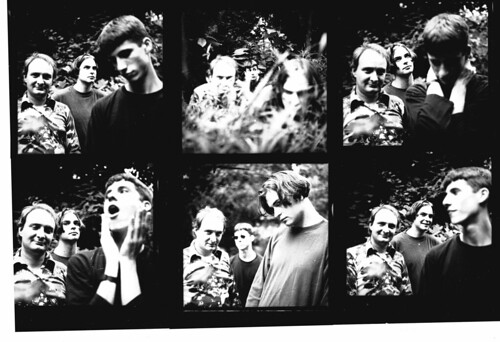
We had the honor of speaking this fall with Lorelei drummer Davis White, guitarist/singer Matthew Dingee and bassist Stephen Gardner, as well as revered engineer and producer Geoff Turner, about the creation of Stove, their thoughts on the Mid-Atlantic indie-pop scene of the '90s, and the legacy of the record today. Each of them gave highly considerate and detailed answers to our questions, for which we are very grateful. Our exchanges below transport us back to that hopeful, youthful and, above all else, inventive time two decades gone. Press play on the record and join us on our deep dive into Lorelei's 1995 classic, Everyone Must Touch The Stove.
Clicky Clicky: Tell us about how the band first began.It makes sense that a band as forward-thinking as Lorelei would not take much time to pause and consider the nostalgia and historical context of the first chapter of its career. One could argue that this was exemplified quite effectively by its comeback record Enterprising Sidewalks, which further expanded the trio's sounds and philosophies within a contemporary context. This author was also, admittedly, unsure how to cap this interview following their sense that Stove saw little fanfare upon release. It's a shame, to be sure. But, in the weeks following our conversations with the band, a silver lining materialized. Lorelei has just disclosed that -- partially inspired by this interview -- it will play Everyone Must Touch The Stove in its entirety at The Black Cat in Washington, D.C. on Dec. 28. While more details about that special event are forthcoming (and we will be sure to alert you within these electronic pages), it is yet another important step toward ensuring that this special piece of art not only establishes its proper place in the pantheon of innovative rock music, but also bends the ears of a new generation of women and men who -- like the members of Lorelei 20 years ago -- enjoy the thrill of pure discovery. For fans in the market for a copy, Slumberland currently has the CD on sale for a ridiculously reasonable price. If you're not already listening to the record as you read these words, stream the entire set via the YouTube embed below.
Davis White (drummer): Stephen and I met at an American University dorm party, in September of 1990. Our bands had played a show together earlier that summer and he recognized me. We hatched a plan to start a band faintly resembling Charlatans UK after Christmas break. Stephen was 14 and I was 29. Neither of us really belonged at such a party, so [it was] quite an unlikely meeting. For brevity and to avoid distraction, we will mostly ignore the myriad early line-ups [of Lorelei] from January to September of 1991 involving (original guitarist) Dave Cerf, Stephen and I. That is a story for another time, and I don't want to short-change all the other fine folks we played with. This period produced our first single "The Bitter Air," so it wasn't a total washout. But I would say Lorelei, as we know it today, began with this post-note from Stephen's mom, "Matt from the Lilys called." It has been folded away in my Boss tuner since that day in August 1991.
Matthew Dingee (guitarist/vocalist): I guess I shouldn't be shocked that Davis has this note. He and Stephen are excellent documentarians. I will say I was definitely formerly of Lilys by that point. [Lilys mastermind] Kurt [Heasley] had been squatting at my apartment while I was in Lilys, which was an awesome arrangement as far as I was concerned (my parents were less enthused). I learned a ton from him and enjoyed it. But that arrangement came to an end, and shortly after I was told by Archie [Moore, of Velocity Girl] that he was my replacement in Lilys. I only mention this because I cannot recall if it was Archie, Kurt, or Mike Schulman who suggested I call Stephen. Regardless, thanks to whomever pushed me in that direction.
DW: Stephen and I had seen Matt a couple of times in Lilys and enjoyed his playing style, recognizing a major The Cure influence. We were ecstatic when he expressed interest in joining us. Dave had moved away to attend his first year at CalArts. So Matt was thrust into playing our legacy material as the replacement guitarist. We played like this for a couple of months, but the old set wasn't sounding very good. By November we had whittled down to a more productive and satisfying trio. We quickly worked up a new set based around songs Matt had written prior to meeting us. The trio first played a fall concert prom at Stephen's high school. To illustrate the timeline, Nirvana's "Smells Like Teen Spirit" was riding high on the top of the charts. Two or three of the high school bands covered the song that night. Matt observed that it was going to be "a hard fight for us to compete with all this grunge."
Stephen Gardner (bassist): I got an early start with music through my older sisters and the typical mid-'80s entry point of The Smiths, The Cure, New Order, etc., choosing to learn bass because one of them said it was "cooler than guitar." I followed them straight to the Dischord scene. People always ask us about being from D.C., and while the music [there] had a huge impact on me, it was the fact that there was this totally youth-organized, completely accessible, all-ages environment of kids doing their own thing that was the biggest influence and created a sense of perpetual possibility. Anyway, by 1990 I had played in a few short-lived hardcore bands and had a show with one of Davis's many other bands, Repercussion, who I had seen several times by then. He, sounding like Joe Jackson and playing a mandolin in a band that was somewhere between thrash and early [Elvis] Costello, was hard to forget. A friend and well-known D.C. photographer, Colby Caldwell, whose photos are on most of the Lorelei records, had gotten me into 4AD stuff and my discovery of a succession of EPs from Lush, Pale Saints, Ride, The Boo Radleys, Slowdive and My Bloody Valentine shifted my whole perception about what was possible -- that there was maybe a way to combine the vitality of Rites Of Spring with the harmonic complexity of The Smiths, all wrapped up in this new depth, texture and space I was hearing on these records. [I was] [c]onvinced I needed to start a new band to make that happen...
CC: What was your experience with the people and places of the Mid-Atlantic and D.C. indie-pop/rock scene from 1990-1996? How do you view that era now? In the context of the label's roster and also in hindsight, Lorelei "makes sense," but at the time did you feel like what you were setting out to do fit well within the regional scene, or did you feel like Lorelei was doing something new and alien?
MD: To us the regional scene boiled down to Dischord and then the labels behind Pop Losers: Slumberland, Teen Beat, and Simple Machines. Within that scene, I was staunchly pro-Slumberland and fairly anti- everything else. Slumberland grew into a tight knit family of friends. Mike and I listened to a ton of records together around this time. It was quite an education. It's hard for me to put into words just how important the relationships built at that time are to me. Slumberland is my tribe and I'm still happy they haven't kicked me to the curb.
Lorelei as a three-piece didn't start off too far afield from Lilys, though much less refined. We played with bands on other local labels and enjoyed that. But fitting in was the last thing I wanted to do. To Mike's credit, he didn't seem to worry too much about whether the roster fit together. He put out records by the bands he liked. He just happens to have inscrutable taste and so it all fits together in the end. For example, despite the fact that we sound nothing like Small Factory, I'd go completely mental when they played. They were so good and played with such enthusiasm. I wanted to do that.
SG: For all the freedom and self-expression that was happening in the punk scene in 1990, it was pretty clear that, sonically, there tended to be a pretty narrow universe of acceptable sounds and interests, particularly from fans of that stuff. I was always a bit confused about that contradiction, but it was clear to me from the beginning that Lorelei was not going to fit in there or find much following in those circles. But, through Vinyl Ink, the 9:30, and DC Space, the wider world was right there, and I think probably everyone involved in these "other" D.C. scenes has the same basic story of being turned on by D.C. punk and applying that energy and method to whatever else they were into.
We found our way to Slumberland right away through my job at Smash Records and trips to Vinyl Ink in Maryland. I had met Mike Schulman, who worked at Vinyl Ink, and learned he had a label and of his legendary knowledge of just about every genre and phase of modern music. I think the Jane Pow single was the first Slumberland release I heard and I remember being blown away by "Warm Room." On that alone, Dave, our first guitarist, and I walked to Vinyl Ink one day in the spring of '91 with a demo and handed it to Mike. He was the first person we gave it to and, luckily, he quickly helped us get our first show -- with the Lilys -- and the 7" followed thereafter.
From there on, the label and the people interested in it and the bands on it became our home base, both because of and in spite of the diversity on the label. Davis and I still stayed connected to our punk roots all the same, and living in Arlington, Dischord, Teenbeat, and Simple Machines stuff was always around. But, the other Slumberland stuff was surely the least popular of any of the scenes in DC. It's hard to know if we were facing explicit hostility or just indifference, but our entire career was mostly spent playing to 30 people in D.C. However, it's important to remember that despite all these labels and bands coming out of D.C. at the time, it was really a pretty small group of people locally that were coming out to see shows of this punk and indie stuff anyway, so the pot of people who might care was always small to begin with, so we are probably wrong to feel too slighted. Each label tended to have its own core of folks and we'd occasionally politely play together, but the only time I feel like this whole punk/indie community really shared a common scene was when everyone would converge at Fugazi shows.
CC: How would you describe the progression that the group saw between the "Bitter Air" 7", "Mimesis" from the ...One Last Kiss comp, the Asleep EP and then the full-length?
MD: You can hear the transition on Asleep. Seeing and meeting Moonshake and Stereolab really connected some previously unconnected dots. Specifically, the Krautrock motorik sound connected with "On the Corner," World Domination Enterprises, and Adrian Sherwood. Plus a heavy dose of Beach Boys and The Wedding Present. I was already listening to more aggressive stuff (The Birthday Party, Skullflower, No Wave) and playing with Mike Schulman and Dan Searing in a post-Whorl noise project. By the time we were working on the Asleep tracks, we were trying to accommodate all these disparate sounds and not rule anything out. Despite having the shoegaze label thrown at us, we were hardly staring at our shoes at this point. There was a fair amount of equipment destruction, blood, sweat, and tears. We practiced at least twice a week for several years and played out a fair amount. With the confidence that comes from playing all the time, we had grown more and more adventurous by the time Stove rolled around.
SG: This is when Lorelei starts to sound like ourselves, I think -- plenty of clear influences, but some weird strands of DNA mutating them into something else. All that was influencing our writing in 1993 and when we went to the UK that fall to promote the EP, we had started working on a few Stove tracks, like "A Thigh For A Leg" [and] "Newsprint."
Although the tour was a disaster in many ways -- proving again that I, all of 17, should not have been left to manage most of the booking and business affairs of the band -- it was crucial to the album in two respects. First, we got to meet and see some of our favorite bands on their home turf, which raised our own expectations of what our next release could and should be. Secondly, having met our makers, so to speak, we confronted the reality that we really didn't fit there, either -- we were too British for America and not American enough for the UK. This had the effect of pushing us away a bit from the Asleep songs and our past influences and making us more determined to follow our impulses and play to our strength -- our diversity of interests -- with more confidence.
CC: What was it like in the time and preparation leading up to recording Stove?
MD: It took what felt like forever for anything to come out. Both in terms of how long it took us to create new songs, as well as the length of time it took a release to reach listeners. Thus I didn't want to include anything from a prior release on the album. Lorelei is all about not repeating. We only started repeating set lists recently (because we have less time now to practice now than we did then). In fact, we had lots of songwriting... guidelines let's say... one of which was that Stephen and I very rarely, if ever, intentionally played the same chord or note at the same time. Repeating a track would have been heresy. That said, Stove, like the rest of our output, is hardly lacking in epics. There is a reason there is a track missing from the vinyl: It would not physically fit!
SG: Our first session for Stove was in February 1994, and we had spent the previous fall and early winter, after returning from our UK tour, writing the first batch of songs. Since we wrote collaboratively during practice sessions, the writing process usually took a long time, and I think we felt pressure to get into the studio, both to capitalize on whatever momentum we had gotten from Asleep, and because the clock was ticking on the band. I had deferred college a year in the fall of '93 to keep things moving with Lorelei and work some before hitting the books again. I think we all knew that the band's future was somewhat in question once I left for school, and that this was our chance to make a great LP. Our own expectations were set high, and having developed a better understanding of the recording process and done Asleep with Geoff Turner, we were anxious to try new things out.
Geoff Turner (engineer, producer): In that time period my studio WGNS was recording records for local independent labels like Teenbeat, Simple Machines, Dischord, Jade Tree, et al. Lorelei was a good fit for our place. They were all recording enthusiasts and had their own studio. They were also hopeless record-dissecting geeks. Listening back to the album 20 years later, I'm pleasantly surprised by how unyielding the record is, with odd song structures, abrupt time signature changes, and sonic bombast. It's really epic, but not an album with tons of what you'd call (in early '90s speak) "cross-over potential."
CC: What was it like recording with Geoff?
DW: I had known Geoff in passing from the '80s hardcore scene. A friend of mine had joined a Dag Nasty offshoot band and they were recording at WGNS. I tagged along. Sitting in the control room, the convenient Arlington location and equipment impressed me. "How do I get Lorelei in here?" I wondered. We had been using a studio in Maryland for "Bitter Air" and "Mimesis." Due to year-long bridge construction it required a very inconvenient drive to get there. The band were reluctant (to varying degrees) when I suggested using Geoff's studio for the upcoming Asleep EP — worried we would end up with an "American-" or "punk rock"- sounding record and wanting to remain loyal to our previous producer. Matt and Stephen were students; being the only full-time worker, I probably strong-armed them into accepting WGNS by refusing to pay for anyplace else. Conflict is how Lorelei works, something the other mates celebrate more than I do. More examples to come, dear interview reader! Geoff quickly won over the guys via a studio tour, and the recording and mixing sessions went well for these four songs.
SG: I was a big fan of Geoff's earlier bands Gray Matter and Three, particularly of Gray Matter's Take It Back EP. It's probably true that I was longing for a Guy Fixsen production -- which we'd eventually get to do on Enterprising Sidewalks -- and depressed that such a thing was obviously impossible when Davis brought up WGNS and Geoff. But from my recollection, I was excited about working with Geoff and secretly hopeful that he'd turn out to be someone from my early cast of heroes that was actually into what we were trying to do. He turned out to be just that, plus exceedingly patient with our strange band dynamic, relentlessly positive, open to trying just about anything, and full of good ideas. He really was a good fit for us...
DW: After [our] sobering tour of England for Asleep -- documented in Robert Salsbury's [tour film] "If You Don’t Try, Nothing Ever Happens" -- we agreed the next step would be an album. There was a feeling that if the band broke up without being able to produce even one album, it would render Lorelei a failure. My slacker job doing graphics at a print shop did not pay enough to record at WGNS again. We borrowed ADATs and microphones from my previous band and did most of the tracking ourselves. We recorded at Stephen's house in the woods of North Arlington. Committed to continue working with Geoff, we were able to do select overdubs and mix the album with him. The first session produced "Thigh For A Leg," "Newsprint," "Windmill" and "Stop What You're Doing." Geoff seemed to enjoy the freedom that came with not making a spartan punk rock record. His own projects Senator Flux and New Wet Kojak were very innovative and somewhat before their time. Geoff saw that we were game for complicated sound-effects and unnatural timbres. Nothing was automated, so the effects were done live during the mix, often requiring three sets of hands and 20 minutes of set-up. There was a look of joy on his face when he heard the finished effect. Trying to keep Geoff happy and hiding any major band dysfunction from him was my goal for a time.
MD: We mixed some of the tracks in Avalon Studio in Bethesda, MD, which was well-equipped. I very distinctly recall that Geoff used every single piece of equipment in the place for the climax of "Crimelab." He genuinely seemed to enjoy that we wanted to push what could be accomplished in a studio at that time. He was a willing and enthusiastic collaborator. Geoff also put up with a significant amount of in-band bickering, which I didn't appreciate nearly enough at the time. Thanks, Geoff! I'm not sure why he tolerated us, honestly. I'm not sure I would have had the patience if I were in his shoes.
WGNS was a comfortable place to record, which is crucial. We didn't have to explain ourselves to Geoff. He got what we were about. So in that way it was huge relief to not have to go into a hostile environment and record. It sounds stupid now, but at the time we really were concerned that if we went to Inner Ear, for example, that our record would come out sounding... not like us. Just getting someone to try what you wanted to try in a studio was not a given. There were plenty of places that would have happily taken our money and not helped us much at all. I can't recall a single instance of Geoff discouraging us from trying something. As Stephen mentioned, Geoff was infinitely patient with us and I'm eternally grateful.
DW: Yes, the second set of songs were mixed four months later at Avalon. Geoff had worked out a deal with owner Steve Murphy to use the studio during down time at a discount rate. Matt had borrowed Stephen's 4-track and composed most of the remaining songs in a couple of weeks. The arrangements were done quickly and recorded at Stephen's house while the songs were still fresh. I was barely able to make it through many of them during tracking, as the drum parts were trickier. "Throwaway" has a particularly bizarre, looping beat, but it wasn't jungle-inspired. The band had rejected my initial, simple 2-4 snare. On the spot I came up with the stupidest rhythm I could think of to appease them. The joke was on me, as it sounded perfect. Matt adjusted his part to fit the new syncopations and off it went.
Overdubs were done over the next two weeks. The heavily-layered guitars were tri-amped through a Danelectro 3x10 combo, Acoustic 4x12, and Fender Bassman, live-mixed to one track. Looking at the tracking sheet, we had 4-7 tracks reserved for guitar out of the 16 available tracks on the ADATs. The unusual instruments [borrowed] from the Woodlawn [school] instrument room for this session included a double bass, some tuned woodblocks, conga drum and the Gardner family piano. Through a fortunate error, a cheesy orchestral percussion track on "Crimelab" did not get transferred to the 24-track mixing tape at Avalon.
"Crimelab," "Today's Shrug," and "Quiet Staid Debt," were mixed on a Friday night and Saturday at Avalon. My insistence that we dial-down the excesses on "Debt" -- as I wanted prominent, uncompressed, crystal clear, jazz-drums -- well, it sure put me on the bad side of Geoff and the group. I left the session mid-day, after that track was mixed, having worn out my welcome. "Day," "Throwaway," and "Pillar" were mixed without me. This explains why (among other "innovations") the snare drum is panned 100% left on the last track. Snickering aside, when I first heard these mixes I was struck that the final product "didn’t sound like anything else." We had finally achieved a unique band voice. If it was unmarketable, so be it.
CC: How was the experience of recording the album? Fond memories and stand-out experiences?
DW: After transferring the ADAT to Geoff's 1-inch 16-track machine, we did a couple of overdub sessions for the first group of songs. I remember walking into his studio and Matt was flat on his back singing "Windmill" into the bottom of a piano. I knew it was going to be a weird afternoon. Stephen directed me to "help unload the car." We doubled-up on marimba, Matt played a dissected Hammond organ that Geoff was fixing, some group percussion was added, [it was all] totally spontaneous and enjoyable.
SG: I remember very little of the first session, but recall that we took over my house for the tracking, with different instruments set up in different rooms so we could experiment with additions once we got basics down. I remember playing the xylophone parts on "Quiet Staid Debt" on my bathroom floor. In those pre-Pro-Tools days, we spent a lot of time getting takes right or overlooking imperfections for the sake of overall sound or feel. Davis did all the engineering, which was a godsend, and I think Matt and I did overdubs separately with him. We had very little money for the band and almost always lost more than we made per show, so the fact that Davis was a good engineer with lots of his own and borrowed gear was a big advantage. If we had had to pay someone to engineer during the tracking phase, we would not have been able to spend nearly as much time as we did on those songs.
MD: I recall that we did the basic tracks fairly quickly because, again, we were playing often at this time, and so the songs were well-rehearsed. Then we spent forever and a day on overdubs because we were definitely in a "more is more" frame of mind. I can only imagine what we would have created if we had access to a tool like Ableton Live back then. We would have gone ballistic.
Then, vocals were also done fairly quickly. I was being petulant and wanted the vocal delivery to feel "live," or at least sound like one cohesive performance. So I think some of the tracks might even be one take. There was a fair amount of punk attitude in me at this time, and I suppose that's where it shows the most. It was like "Fuck it. Doing it in one take. Not worth the time. Let's mix again!" We did not scrutinize every line like we do now. If there is anything I would change about the record, it would be most of the vocals ("Crimelab" and "Windmill" are okay, but the rest could use some assistance).
GT: My memories of recording this album are almost completely fragmented. Obviously this album was mixed in a pre-ProTools, analog console world, so all of the dynamic and tonal changes, shifting effects, and fader moves were mixed down live by hand to the master tape. When I think back to the sessions, I just remember all of us sitting in close proximity over the board debating mix moves. I joined in these debates willingly. There were a lot of manifestos delivered during the sessions, but I don't recall much stress or hassle. They indulged in constant but good natured goading and ridicule amongst themselves, but that was all really funny and OK. I don't remember eating good food or going out much, [so] we must have been working really hard.
"Inside The Crimelab" still stands as one of my favorite mixing sessions and I’ve had déjà vu back to that day while working with other bands. We built this mix that was so geometrically crisscrossed with delay paths and wobbly instrument treatments that it was completely disorienting even to us during the mix. That song still has that temporal rift effect for me listening back 20 years on, the beat and stereo space just seems so bent by the mixing.
Matt would go out into the studio, actually I believe we sent him into the tiny studio restroom, to record these crazy emo-fueled shrieking freakouts, like cathartic vocal outbursts. These were overdubs and were mixed in low during the parts of the songs when the guitars detonated your speakers. I can't remember which songs had these screaming tracks, but on re-listening I'm imagining that I'm hearing them on every song all over the album, which is cool.
The band really acted as their own "producer" and by the recording of Stove they had devised an arrangement wherein each band member assumed the role of executive producer for certain songs. So Davis's opinion (for example) was given the most weight for the recording and mixing direction on that particular song and became like his mini-fiefdom. This worked out really well, brought variety to the album and cut the endless discussions and bullying to a minimum.
CC: There seems to be a lot of less-conventional recording techniques and details within the songs, including very uniquely panned tremolos, delay sounds and distortion effects. What’s going on there? What inspired that? How much of it was a reaction to other things happening at the time?
SG: Partly, this comes from just getting deeper into the recording process and listening much more for production. Davis entered the band already knowing what he was doing in the studio, but Matt and I both came to really understand production through recording in Lorelei, which in turn, changed the way we both listened to records and what we wanted from our own. As cliché as it may be, we had come to see the studio as another member of the band and wanted to put that new member to work. The other factor is that we had way more gear at our disposal than normal in the mixing process, so part of this is just the desire to use all the toys we had.
DW: Geoff and the band would ponder each of the 16 instrument tracks with a "what can we do to this" attitude. Sometimes, one simple change, such as "Crimelab's" distorted conga drum that Geoff came up with, would redefine the song. This would influence the next effect, and the one after that, until we ran out of patches. The bass guitar was spared any tinkering and had a simple chain throughout. It was recorded direct, then run through a Peavey tube preamp during the mix. Stephen didn't yet have his amazing Acoustic 360 bass "refrigerator" for much of the recording of the album, unfortunately.
MD: I believe Lydia Lunch said something along the lines of "Do anything but start a guitar/bass/drums 3-piece" in regards to the birth of No Wave. I became enamored with the idea that our setup was just done, cooked, over. That resulted in my trying to torture and mutate the guitar sound into something else. Mainly because I could not adequately play anything else, but also because we recognized that mutation in the bands we enjoyed. Look at Slowdive and Seefeel: guitars are certainly there, but they hardly sound like a guitar plugged into a RAT distortion pedal and then into an amp. [T]hat is essentially what most bands around us were doing and I just found that... underwhelming.
But the other thing to mention here is that Lorelei as a three-piece has always had alternately tuned guitars (inspired by Sonic Youth and Bailter Space). "Stale Houses" [from Asleep] is the last song I played a traditional tuning on. I use an open tuning (EAEABE), and that combined with distortion and EQ helps me generate this giant, full sound that lends itself to the effects and manipulation you hear on the record. That sense of experimentation, wanting to have a unique guitar sound, being inspired by noise, controlling and warping of sound is there from the very start and continues through all of our material.
CC: How was the public and critical reception to the album at the time of its release in your view? Was there a tour in support?
SG: We finished mixing the LP in June or July of '94 and it would take over a year for it to come out. Like all of our releases, the time it took to get the record out was a complete killer. These delays were always due to some combo of our incompetence, Slumberland's challenges with money, distribution, etc., and just the way things worked then. My recollection is that the release was essentially ignored. Part of that was our fault. I was already starting my second year of college, so we had really reduced the amount of shows we were playing, plus we had all started other projects to fill in for Lorelei while we couldn't play together. Of course, we didn't have a press or booking agent, and didn't tour for the record because, by then, time was limited and we could never seem to make touring cover our costs. So, it was pretty much destined to fail, but in addition to these self-inflicted factors, I'm sure we faced the normal hostility or disregard we had experienced from most of the US music press. I think The Ropers' All The Time, which was released together with Stove by Slumberland that same week, faced a similar response. While there was some solace in the fact that other great records [of that time] like Bark Psychosis' Hex and Disco Inferno's DI Go Pop... which seemed to be springing from the same well as us, were getting ignored, too, we struggled to understand what to do about it.
CC: So what happened next?
SG: We played several shows that summer and fall of 1995 and into the winter with the release of the LP, for which we had a single record-release show in D.C., being pretty sick of the songs by then since they were all more than a year old. We had written a new batch of songs during the summer of '95, most of which we recorded then but didn't mix until 2001, long after we had disbanded. Our last show was in early 1996 in Baltimore at a strip club that had occasional shows. One of my best Lorelei memories was of Matt taking a running leap, guitar-first, into the stripper'’s pole, with the pole working like a giant slide against the fret board. With me back in school in Massachusetts, everyone with new projects, and us with an LP we felt proud of but that failed to register with nearly anyone, it seemed pretty obvious that the time had come to pack it up. Luckily, the end was not acrimonious and, despite lots of challenges between us, I think we all left the band as friends, feeling like we had accomplished something important and with our respect and admiration for each other intact. This was obviously essential to our later work together.
DW: Band activity was next to zero after a brief flurry of shows to promote the album. Tired of dealing with the acrimony, I had adopted a "teamster" persona by this time, contributing only minimally to anything new. We limped along during Stephen's college breaks until Matt decided to move to San Francisco. I was sad to see him go, but relieved the band was over. When I heard the news, I gave out a dramatic 20-second exhale.
MD: We moved apart. I released a Lorelei EP on my label Textilesounds. Then I moved back to the area in 2006 and we made Enterprising Sidewalks, which we hope folks will also find and enjoy over time.
CC: One of my favorite music articles is Nitsuh Abebe's Pitchfork piece "The Lost Generation," which includes Stove as a defining work of the hard-to-categorize post-rock movement. What are your thoughts regarding that? Do you feel that there was "something in the air" during that time that led to the kind of innovations that he mentions?
MD: It’s nice to be included in the same breath as Disco Inferno, Laika, Pram, Main, etc. I'm not sure I would put Stove at the same level as Laika or Main. They are operating at a different level.
I do rankle a little bit at being put into the "Followers and Fellow Travelers." I don't know which one applies to us, but it feels a bit like the "also rans." I mean, we are American despite not being from Chicago. And if you look at when our record was recorded... there is no way we are a follower of any other American band that you would describe as post-rock. We were recording at the same time as those "Lost Generation" bands. So, for what it is worth, we were there. We were there in that same head space at that same time. You would have had to come to D.C. to see it, but it was here to see.
But in the end we're all quite pleased that the record has found an audience over time. None of the divisions in sound, place, time, [or] label matter as much any longer. At times it was frustrating, but for the most part it was an exciting time to be making music.
Lorelei: Facebook | Interzizzles