Showing posts with label Lilys. Show all posts

August 25, 2016

Today's Hotness: Strange Passage, Snowball ii, Mendez

Strange Passage -- Shine And Scatter EP (detail)

>> Our music fandom is reborn with each great surprise, as when the unexpected find flips up against our thumbs in the record bin, or when a sound we love appears out of the blue right in the blog's backyard. This latter circumstance is what has us jazzed lately, said jazz having been sparked when friend-of-the-blog Jeff Breeze sent us a link to a smashing new debut EP from upstart Somerville, Mass. four Strange Passage. The quartet's Shine And Scatter EP echoes the melodic, guitar-centered sound of the turn-of-the-'90s UK with surprising competence and confidence. Indeed, the short set's four songs echo The House of Love and the early RIDE EPs, and -- more contemporaneously -- are startlingly reminiscent of the massively underrated and short-lived aughts combo The Boyfriends. While there is a thread of shoegaze shot through Strange Passage's alluring brand of guitar pop, and Boston continues to have a strong share of contemporary 'gaze practitioners, Strange Passage's music still feels somewhat delightfully off-trend. There are just not a lot of acts out there right now trying to write the next "Chelsea Girl" or "Shine On," are there? Shine And Scatter also boasts some production choices that make the EP feel particularly mature for a debut, including putting an understated, even-keeled vocal up front in the mix. It's a confident, but not showy, move. And so it almost feels as if Strange Passage has foregone the trials and travails of writing a first and second EP, and have just jumped in with a terrific third. Each song is dynamite, but the uptempo rager "Viaducts Burning Down" stands out with its urgent intensity, and the repeated feeling of resolution that comes with each recitation of the title in the chorus. Shine And Scatter was recorded through the late spring and early summer with hit-maker Will Killingsworth at Dead Air Studios in Western Mass. and self-released via Bandcamp Aug. 16. As impressive as its EP is, Strange Passage has yet to play a show; its first live outing is slated for Sept. 30 at The Democracy Center in Cambridge, Mass., where they will be joined by Amherst, Mass. noisemakers Dirt Devil and -- we're told -- others. We're torn about urging everyone out to the show, as every band deserves a chance to get its collective feet under them before being subjected to scrutiny. But all the same, we feel like it's going to be exciting seeing Strange Passage blossom, so, you know, you should probably go. Stream all of Shine And Scatter via the Bandcamp embed below.


>> That LA dream-pop concern Snowball ii jumps styles with its new album and latest single "I Doughnut Want To Live" is little surprise, given band mastermind Jackson Wargo may consider notable shape-shifter Kurt Heasley's long-running, magical Lilys one of his lodestars. Snowball ii's clever February 2016 debut long-player ? was often a devoutly shoegaze affair, and its most recent music prior to "I Doughnut Want To Live" were spooky, ethereal covers of Lilys' "Black Carpet Magic" and "Day Of The Monkey" for Colorful Acts: In The Presence of Lilys, a Lilys-themed compilation issued by The Blog That Celebrates Itself over the summer (for short-tenure Clicky Clicky readers, if the prospect of a Lilys comp excites, you should also check out our own). And while much of the Snowball ii's forthcoming sophomore set feels influenced by Sufjan Stevens, the appealing ballad "I Doughnut Want To Live" stands apart in the new collection. The deceptively serene song is built up from patient acoustic guitar strums and glistening leads in the verse whose optimism plays against Mr. Wargo's somber confession in the chorus ("'cause I don't think I can love her like I did before."). "I Doughnut Want To Live" is the first taste of Snowball ii's long-player Doughnut Holes, which the band recorded and produced at its own The Doughnut Shop studio and will released via its own Doughnut Records Sept. 16 (sense a theme? -- Ed.). Snowball ii celebrates the record with a release show the same day; a third Snowball ii LP is slated for 2016 release as well. Stream "I Doughnut Want To Live" via the Soundcloud embed below.


>> Singer and songwriter Gregory Mendez has made a bunch of music over the years, and a fair amount of it with input from The Superweaks' Evan Bernard, among others. Projects including Airport and Getting Sick eventually led to a well-received singer-songwriter thing under his own name, perhaps out of a desire to simplify. That presumed yen is manifested both in Mr. Mendez's new moniker and music; his latest effort Phone Records is attributed to the yet-more-concise Mendez, and the self-released collection features nine tunes tracked to a smartphone app. We mention the means of production here not to encourage folks to start sending us an avalanche of crap they made on their phones, but to underscore that it is still novel to encounter a recording made on a phone that is this good. The trick, of course, is to start with great songs or song ideas, as Mendez does. Phone Records presents what may be an unanswerable chicken and egg question: is the intimacy of these recordings enhanced by capturing the bedroom sessions on a phone's tiny microphone? More likely the production is just a side-effect of making do, but there is substantial charm to the feeling of "being there" as Mendez plies his trade. Songs including "Try" and "Control" firmly echo the balladry of early Elliot Smith (although the latter tune cleverly incorporates the synth melody from Soft Cell's iteration of "Tainted Love"), but Phone Records' more dynamic tunes, such as the shuffling, early Yo La Tengo-styled "Stained Glass Boys" and "Gum Trash," are its strongest. Album closer "The Drug Trafficker's Daughter" feels demo-ish in the way one would expect a phone recording to be, but that's the other side of the "hey-this-was-recorded-with-a-phone!" coin: some stuff feels like an idea waiting for fuller treatment. But the bulk of Phone Records feels accomplished, evidence that while Mendez may be seeking simplicity, his songcraft remains robust. Stream the entire thing via the Bandcamp embed below; the cassette-inclined will be pleased to know they can get a limited edition physical artifact from Houston-based Some Weird Sin Records right here.


May 8, 2016

Today's Hotness: Hellier Ulysses, Lacing

Hellier Ulysses -- Prime Example (detail)

>> This reviewer thought that this day might come, when an indie rock release would cross his path and defy all efforts to categorize or "name" it (well, not _all_ efforts. -- Ed.). It arrived earlier this spring: Prime Example, the sophomore set from Atlanta's Hellier Ulysses, is exactly that. Issued on cassette in mid-March via Brooklyn's OSR label, the set offers up seven jazzy, minute-long post-punk cubist head-scratchers that nevertheless remain catchy and pack enough ideas to power an hour-long double album. Comprised of musicians "Advantage Fire, Humidity Ott, Pit Moder and San Forest," the Georgia quartet operates at the frontier of imagination and musicianship. During preview track and collection highlight "Genesis Is Dispersion" the group funks through a tough, Stax-styled guitar intro before sidelining into a brief, country-fried blues verse and a helium-voiced response, before the sweetly sung hook "I just can't let go" floats over three breezy chords. The warm, vintage-sounding and playfully overdubbed words and effects that pepper this tape call to mind '60s pop experimentalists like Godz, The Mothers of Invention and The Velvet Underground at their most unhinged and quirky -- a rarely employed inspiration within more conventional indie rock that works great here as deployed with mathematical precision by Hellier Ulysses. "Eat the Police," another highlight, balances clattering No Wave dissonance with bizarre time-signature fret runs and a hip-shaking disco beat. Really. In an age where so much new art seems to build upon the past, it is striking how much fresh humor, expression, originality and economy these four musicians conjure seemingly out of thin air. Prediction: in 40 years, a group of kids at the vanguard of 2060's youth culture will name-check Prime Example, and the world will have finally caught up to Hellier Ulysses' level of invention and hyperactivity. Get in on the ground floor now: order the cassette or grab the digital files from OSR right here. Hellier Ulysses' debut collection Hellier Ulysses was self-released by the band in 2013 and issued on cassette by Egg Paper Factory a year later. According to a statement at its web site, nine-year-old OSR is winding down operation in 2016; the outfit's commitment to releasing innovative music is commendable, and we hope the label's proprietors will remain involved with identifying and exposing talent in some fashion going forward. Stream Prime Example via the embed below. -- Edward Charlton


>> Whispered, mysterious, bruised and grinding: that's the way we prefer our classic shoegaze, and Chattanooga's Lacing seem to have -- in some sort of "Weird Science"-esque scenario -- taken those qualities and used them to create a pristine swimsuit model version of the sound. This, folks, is the stuff. On the quartet's four-track, self-released debut cassette Honey Glow, Lacing assaults the senses with tidal waves of distorted and treated guitar, crashing drums and barely-there vocals, creating crescendos of impressionistic melody all along the way. Ever since the twinned landmark albums of 1992 -- The Ecstasy of Saint Theresa's Susurrate and Lilys' earth-shaking In The Presence of Nothing -- this reviewer has pined for similarly hushed and alluringly veiled music that retains a live, practice-room exuberance. Honey Glow deliciously scratches that very specific itch. A lone, flanged guitar ignites opener "Gloom" (a guitar effect rarely pulled off tastefully, we might add) before the figurative skies figuratively open up and thunder and rain flood the stereo field. The drumming, in particular, gives these songs a spirited immediacy, and echoes the sturdy gallop of post-'gaze groups like Hum. Collection highlight "Needle" switches primarily between two sections in the style of My Bloody Valentine, but does so with such manic fervor that its three minutes feel like one. And, after three short and pounding doses of noise-pop perfection, Lacing closes its abbreviated set with an epic title track. The tune offers 11 minutes of glistening sheets of suspended-animation guitar notes that accumulate into sense of time-traveling curiosity. Everything about Honey Glow leaves the listener wanting more; in our modern age of over-sharing and lack of subtlety, the EP offers a powerful and addicting experience and marks Lacing as one of the most vital concerns of 2016. Buy the cassette now from their Bandcamp wigwam here -- at press time only seven of these gems remained. To circle back on the Lilys record briefly: Frontier Records strongly hinted here in March that it will reissue In The Presence Of Nothing this fall. Keep your fingers crossed. -- Edward Charlton


November 14, 2015

Today's Hotness: National Park Service, Floral Print, Light Heat, Sun Gland

Today's Hotness: National Park Service, Floral Print, Light Heat, Sungland

Ever since we turned on to the Lakewood, Ohio-based ambient/experimental concern National Park Service a couple years back, the anonymous, five-year-old act has kept us busy, releasing extensive, quality albums of atmospheric post-everything sounds that, frankly, have just stunned. The music asks more of listeners than pop music or even indie rock, so it might be more easy to take its brilliance for granted. But even so that brilliance -- indeed, we consider National Park Service the Aphex Twin of autumnal folk-drone and melodic ambience -- is underscored once more by Everyday Feelings, a recently issued, 14-track odds 'n' ends compilation of hard-drive rarities from the past year. The collection commences with "Disillusion," a bass-y synth exploration limned with a crisp live drum beat. The composition delivers listeners into optimistic head space, introduces samples of conversation, and then the piece is knocked aslant as it is run through a hi-pass filter before evaporating. The composition "I Have Not Forgotten" presents warped post-shoegaze chords that rumble in the distance while field recordings of chirping crickets and cicadas approach the top of the mix, which surprisingly approximates well the experience of standing in a muggy Southern field next to a highway overpass. "Light Up" is a fully formed post-rock masterpiece of looping guitars and percussion that vaguely resembles the start-up modem sounds of yesteryear. The song packs enough dynamics and continually evolving textures to believably show up on the next Mogwai album. It's that good. Everyday Feelings was self-released as a digital download to the wilds of the Internerds Oct. 11. Stream the entire compilation via the embed below, and click through to download Everyday Feelings for any price. While you're there, be sure to catch up on the other albums as well, especially the recently released '97 Tracer (which we wrote about here) and the undisputed 2013 classic I Was Flying (which we wrote about here). -- Edward Charlton


>> Special things continue to brew in the Atlanta indie rock scene. There a wave of bands proffering mathy, punky post-pop guitar music and bent on rewriting the compositional rules ply their trade via emotive lyrics and clean, disarming instrumental figures. Scene figureheads Red Sea and Warehouse both went big in 2015 with releases that deservedly drew national attention (albeit in the underground). Cresting presently is the trio Floral Print, whose recent two-song digital single more than delivers on the promise of its entirely terrific but undersung 2015 EP Woo [seriously]. The single's de facto A-side "Running Joke" presents dizzying, chipper-to-somber tempo changes within its first minute, but the tune stays anchored to strong vocals and the side-winding melodies of guitarist Nathan Springer. Fans of the masterful post-punk mods Each Other should certainly take note, as the tune contains a similar entrancing logic. Flipside "Alice Arm" at first operates on a lopping Pavement-esque verse (think "Grounded") before interrupting itself repeatedly with dreamy post-rock interludes saturated in heavy delay moves. Both tunes evidence an act with highly imaginative, forward thinking songwriting, firing our anticipation for the planned physical release of these two cuts and possibly more soon via Philly-based tape and vinyl label Bacon Beak Records. If you're lucky enough to be in Atlanta on Nov. 21st, be sure to catch Floral Print with the venerable Swings at the Mammal Gallery. "Running Joke" b/w "Alice Arm" was released to the wilds of the Internerds Oct. 8; stream both tunes via the embed below, and click through to download the set for any price. -- Edward Charlton


>> Perhaps one day erstwhile Philadelphia psych-pop act Mazarin, which released three sparkling and wistful albums between 1999 to 2005, will garner the totality of praise it so richly deserves. That band's towering final collection, We're Already There, adhered to its own singular logic, and in doing so superseded the group's masterful, skittering guitar pop to don an elegant, velveteen shoegaze shroud. The set not only featured a Kurt Heasley (of our beloved Lilys) cameo, but also gave the then-en vogue The Shins a run for their melodically pleasant money, while paving the way for similarly inspired scene contemporaries Dr. Dog. And that's all without even mentioning Mazarin's must-own 2002 "Memories Change In Patterns" single, released on the venerable Sub Pop label. Following this fully realized run? Silence, then an announcement that the Mazarin moniker was surrendered under legal threat to a lame bar band, then a brief name-change to Black Stoltzfus, then... nothing. Mastermind Quentin Stoltzfus thankfully -- and as chronicled here in these electronic pages in 2013 -- resurfaced at long last with Light Heat, a new group featuring key members of Mazarin. As quick as the act's self-titled debut arrived from seemingly nowhere, the band receded back to the shadows, and only the rare blog post provided hope that new music from Light Heat might be forthcoming. Then, just as the aforementioned Lilys was set to launch its short strand of shows in October with support from Light Heat, Stoltzus' act announced The Silver Light Of The Late Night, a new five-song collection. The EP retains Stoltzfus' trademark meandering verse melodies and steady vocals but marry them, at times, to a more neon-lit, club-going, dream-pop aesthetic. The title track opener sets forth a mission statement, layering billowing delay guitar lines atop a ceaseless, clean hi-hat disco beat without ever sounding at all like a follower of the many other post-2005 bands that have charted a similar course. "You Know About Me" interrupts itself with handfuls of bratty garage rock chords but its angular rhythmic gallop persists throughout. "Villains" perhaps best recalls the Mazarin of old, with opening backwards guitar effects and the sturdy, folksy acoustic strums that formed the bedrock of the early Mazarin sound. The gorgeous and gauzy closer "Under The Spell" surveys the events of the proverbial and perhaps titular night, pleased with the results, though no less wistful (get the feels from that guitar solo) than ever before. It's a beautiful ending to the EP, and a reminder of what makes Mr. Stoltzfus such a special songwriter. Let's hope it is also an auspicious teaser for similarly skilled and moving work that will hopefully follow. Listen to The Silver Light of The Late Night via the Soundcloud embed below. Philadelphia fans can see the act this coming Thursday at the Boot And Saddle, when it supports a bill top-lined by the similarly legendary HiSoft. Full show deets are right here. -- Edward Charlton


>> Glaswegian noise-pop goliaths The Cherry Wave are arguably one of the most six-string-centric acts around, as evidenced by its stinging feedback and twisted, distorted chords, so the idea of a solo project from its bass player Billy may seem a dubious proposition on its face. What's this surnameless bass player got to offer, anyway? The answer, it turns out, is quite a lot. Operating under the moniker du rock Sun Gland, Billy purveys refreshingly nuanced and frenetic post-punk. Sun Gland's debut offering is a five-song EP titled Songland (get it). The music switches out The Cherry Wave's devastating feedback swells for angular jabs of minor chords and guitar lines much more in line with experimental post-punkers like Women (and its offshoot soon to be formerly known as Viet Cong), TV Wonder, The Dories and other practitioners, most of whom hail from Calgary, Canada. There is, however, just enough of The Cherry Wave's shoegaze texture to appreciate a connection between Sun Gland and its proprietor's day job. Opener "Miracle of Hate" casts plaintive, far-off vocals against piercing, overdriven blasts of guitar to summon a stunning, funereal stomp. "Glinted" opens with delicately picked, moody guitar arpeggios, but surges with a strong "folding into a light" chorus refrain. EP highlight "Chime" expands on these blueprints, but packs it into a breath-taking, punky minute-and-a-quarter blast. Closer "Ochre" plots a somber, slow-dancing approach for much of its duration, sounding like a more discordant Ride, but one unafraid to steer recklessly toward a locked-groove churn. In all, Songland is a fabulous and promising collection, and one that not only establishes a very separate realm for Billy, but also is equally impressive as nearly all of the instruments are played by just the one dude. Stream Songland via the embed below, and click through to download it for any price. It is very well worth noting here The Cherry Wave's recently issued split single with like-minded noise-poppers Airs.The release includes a brace of tunes from each act, with The Cherry Wave offering two anthems notable for actually feeling, well, relatively -- relatively -- restrained, even conventional. Opener "Still Light" is surely a paint-peeling rocker, but with a more pronounced melodic sense than we've heard from the band before; the blissfully cacaphonous "Swedger" hews more closely to the classic Cherry Wave sound. Airs acquits itself wonderfully with its pair, which curiously includes a high-octane take on the Oasis classic "Supersonic," which somehow comes off even more cocaine-fueled than the original. Stream all of the The Cherry Wave/Airs split via the second embed below. -- Edward Charlton


November 4, 2015

Stop What You're Doing: How Lorelei Transcended Its Influences And Produced The Undersung, Prescient Post-Rock Classic Everyone Must Touch The Stove

Stop What You're Doing: How Lorelei Saw Beyond Itself and Produced The Undersung, Prescient Post-Rock Classic Everyone Must Touch The Stove

[By Edward Charlton / UPDATED] Time, place and personnel. These three elements proved to be everything for Lorelei, a misfit trio of adventurous indie musicians whose debut long-playing album, Everyone Must Touch The Stove, turned 20 years old in September.

The time was the early 1990s, when the so-called alternative ethos loomed over both the musical underground and overground, experiencing its first identity crisis when grunge penetrated the purview of high school dances and topped the pop charts. The place was Washington, D.C., where the narrowly realized punk idealism of the '80s had ebbed, giving way to a fertile and diverse scene whose possibilities seemed limitless in the minds of many of its players. And so it was with the band; Lorelei was a challenged and ever-changing project, which -- through a series of fortunate and formative experiences -- chanced upon the ideal combination of the three aforementioned factors to create an expansive, experimental and startlingly prescient indie rock album. Indeed, the long-player Everyone Must Touch The Stove foretold much of the coming post-rock movement, whose influence helped shape the next two decades of sub-popular independent music. Lorelei continues to perform live occasionally, and is poised to announce at least one special performance for the end of 2015. More about that below.

Following a series of terrific compilation tracks, singles and the beautiful Asleep EP -- recordings whose sounds closely tracked to the group's rapid development and lineup changes -- Lorelei committed 10 of its most refined and experimental pieces to tape at home and Geoff Turner's WGNS studios in Arlington, Virginia in 1994. Released a year later by the esteemed Slumberland Records, Stove was Lorelei's final statement until a 2006 reunion precipitated the 2012 comeback LP Enterprising Sidewalks. Slumberland calls Stove "a brave album, blending together a vast array of sounds into a bold statement of the possibilities of pop and rock, heading off in a hundred different directions at the same time, but still remaining a cohesive whole." Mr. Turner below positively assesses the record as "unyielding." Clicky Clicky does not disagree on either count.

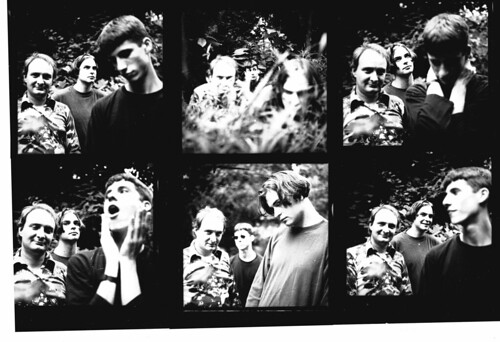
Everyone Must Touch The Stove contact sheet.Opener "Today's Shrug" sets the tone with shifting melodies, guitar feedback and the act's endlessly creative and sturdy rhythm section, all of which underpin evocative lyrics and uniquely emotive vocals. Throughout the album, highly technical, stereo guitar effects workouts ("Thigh For A Leg," "Throwaway," and the otherworldly centerpiece "Inside The Crimelab") mingle with power-pop rockers ("Newsprint," "Stop What You’re Doing") and polyrhythmic acoustic instrumentals and interludes ("Day," "Windmill") for a curiously wandering and dreamy listen that seems to exist both within and without the era in which it was created. Even now, Stove's terrific songwriting and artful textures intrigue new fans discovering the record for the first time. While it is Clicky Clicky's experience that we rarely encounter a musician that says they were directly influenced by the band (even Allmusic.com paradoxically has nothing to say about the record), it is pretty much the rule that every musician to whom we have introduced Everyone Must Touch The Stove finds it inspiring. To loosely paraphrase one of them, the time is right to reintroduce this exceptional record to people and give it the critical appraisal it deserves.

We had the honor of speaking this fall with Lorelei drummer Davis White, guitarist/singer Matthew Dingee and bassist Stephen Gardner, as well as revered engineer and producer Geoff Turner, about the creation of Stove, their thoughts on the Mid-Atlantic indie-pop scene of the '90s, and the legacy of the record today. Each of them gave highly considerate and detailed answers to our questions, for which we are very grateful. Our exchanges below transport us back to that hopeful, youthful and, above all else, inventive time two decades gone. Press play on the record and join us on our deep dive into Lorelei's 1995 classic, Everyone Must Touch The Stove.
Clicky Clicky: Tell us about how the band first began.

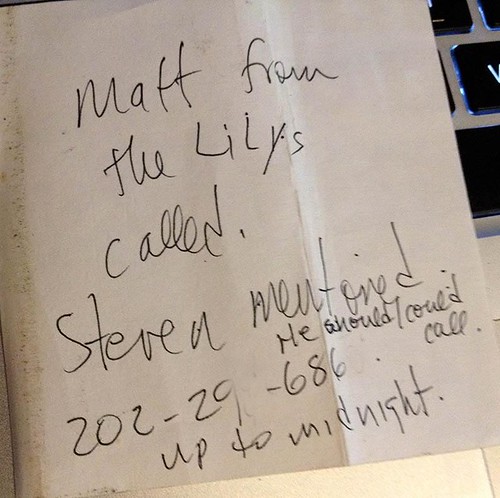
Davis White (drummer): Stephen and I met at an American University dorm party, in September of 1990. Our bands had played a show together earlier that summer and he recognized me. We hatched a plan to start a band faintly resembling Charlatans UK after Christmas break. Stephen was 14 and I was 29. Neither of us really belonged at such a party, so [it was] quite an unlikely meeting. For brevity and to avoid distraction, we will mostly ignore the myriad early line-ups [of Lorelei] from January to September of 1991 involving (original guitarist) Dave Cerf, Stephen and I. That is a story for another time, and I don't want to short-change all the other fine folks we played with. This period produced our first single "The Bitter Air," so it wasn't a total washout. But I would say Lorelei, as we know it today, began with this post-note from Stephen's mom, "Matt from the Lilys called." It has been folded away in my Boss tuner since that day in August 1991.

The post-it note that started it all.Matthew Dingee (guitarist/vocalist): I guess I shouldn't be shocked that Davis has this note. He and Stephen are excellent documentarians. I will say I was definitely formerly of Lilys by that point. [Lilys mastermind] Kurt [Heasley] had been squatting at my apartment while I was in Lilys, which was an awesome arrangement as far as I was concerned (my parents were less enthused). I learned a ton from him and enjoyed it. But that arrangement came to an end, and shortly after I was told by Archie [Moore, of Velocity Girl] that he was my replacement in Lilys. I only mention this because I cannot recall if it was Archie, Kurt, or Mike Schulman who suggested I call Stephen. Regardless, thanks to whomever pushed me in that direction.
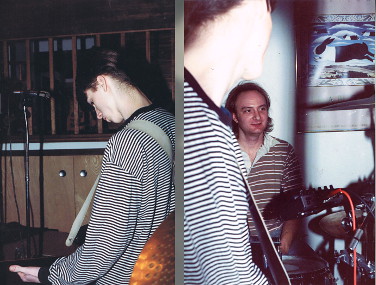
DW: Stephen and I had seen Matt a couple of times in Lilys and enjoyed his playing style, recognizing a major The Cure influence. We were ecstatic when he expressed interest in joining us. Dave had moved away to attend his first year at CalArts. So Matt was thrust into playing our legacy material as the replacement guitarist. We played like this for a couple of months, but the old set wasn't sounding very good. By November we had whittled down to a more productive and satisfying trio. We quickly worked up a new set based around songs Matt had written prior to meeting us. The trio first played a fall concert prom at Stephen's high school. To illustrate the timeline, Nirvana's "Smells Like Teen Spirit" was riding high on the top of the charts. Two or three of the high school bands covered the song that night. Matt observed that it was going to be "a hard fight for us to compete with all this grunge."

Stephen Gardner (bassist): I got an early start with music through my older sisters and the typical mid-'80s entry point of The Smiths, The Cure, New Order, etc., choosing to learn bass because one of them said it was "cooler than guitar." I followed them straight to the Dischord scene. People always ask us about being from D.C., and while the music [there] had a huge impact on me, it was the fact that there was this totally youth-organized, completely accessible, all-ages environment of kids doing their own thing that was the biggest influence and created a sense of perpetual possibility. Anyway, by 1990 I had played in a few short-lived hardcore bands and had a show with one of Davis's many other bands, Repercussion, who I had seen several times by then. He, sounding like Joe Jackson and playing a mandolin in a band that was somewhere between thrash and early [Elvis] Costello, was hard to forget. A friend and well-known D.C. photographer, Colby Caldwell, whose photos are on most of the Lorelei records, had gotten me into 4AD stuff and my discovery of a succession of EPs from Lush, Pale Saints, Ride, The Boo Radleys, Slowdive and My Bloody Valentine shifted my whole perception about what was possible -- that there was maybe a way to combine the vitality of Rites Of Spring with the harmonic complexity of The Smiths, all wrapped up in this new depth, texture and space I was hearing on these records. [I was] [c]onvinced I needed to start a new band to make that happen...

CC: What was your experience with the people and places of the Mid-Atlantic and D.C. indie-pop/rock scene from 1990-1996? How do you view that era now? In the context of the label's roster and also in hindsight, Lorelei "makes sense," but at the time did you feel like what you were setting out to do fit well within the regional scene, or did you feel like Lorelei was doing something new and alien?

MD: To us the regional scene boiled down to Dischord and then the labels behind Pop Losers: Slumberland, Teen Beat, and Simple Machines. Within that scene, I was staunchly pro-Slumberland and fairly anti- everything else. Slumberland grew into a tight knit family of friends. Mike and I listened to a ton of records together around this time. It was quite an education. It's hard for me to put into words just how important the relationships built at that time are to me. Slumberland is my tribe and I'm still happy they haven't kicked me to the curb.

Lorelei, practice, 1990s.Lorelei as a three-piece didn't start off too far afield from Lilys, though much less refined. We played with bands on other local labels and enjoyed that. But fitting in was the last thing I wanted to do. To Mike's credit, he didn't seem to worry too much about whether the roster fit together. He put out records by the bands he liked. He just happens to have inscrutable taste and so it all fits together in the end. For example, despite the fact that we sound nothing like Small Factory, I'd go completely mental when they played. They were so good and played with such enthusiasm. I wanted to do that.

SG: For all the freedom and self-expression that was happening in the punk scene in 1990, it was pretty clear that, sonically, there tended to be a pretty narrow universe of acceptable sounds and interests, particularly from fans of that stuff. I was always a bit confused about that contradiction, but it was clear to me from the beginning that Lorelei was not going to fit in there or find much following in those circles. But, through Vinyl Ink, the 9:30, and DC Space, the wider world was right there, and I think probably everyone involved in these "other" D.C. scenes has the same basic story of being turned on by D.C. punk and applying that energy and method to whatever else they were into.

We found our way to Slumberland right away through my job at Smash Records and trips to Vinyl Ink in Maryland. I had met Mike Schulman, who worked at Vinyl Ink, and learned he had a label and of his legendary knowledge of just about every genre and phase of modern music. I think the Jane Pow single was the first Slumberland release I heard and I remember being blown away by "Warm Room." On that alone, Dave, our first guitarist, and I walked to Vinyl Ink one day in the spring of '91 with a demo and handed it to Mike. He was the first person we gave it to and, luckily, he quickly helped us get our first show -- with the Lilys -- and the 7" followed thereafter.

From there on, the label and the people interested in it and the bands on it became our home base, both because of and in spite of the diversity on the label. Davis and I still stayed connected to our punk roots all the same, and living in Arlington, Dischord, Teenbeat, and Simple Machines stuff was always around. But, the other Slumberland stuff was surely the least popular of any of the scenes in DC. It's hard to know if we were facing explicit hostility or just indifference, but our entire career was mostly spent playing to 30 people in D.C. However, it's important to remember that despite all these labels and bands coming out of D.C. at the time, it was really a pretty small group of people locally that were coming out to see shows of this punk and indie stuff anyway, so the pot of people who might care was always small to begin with, so we are probably wrong to feel too slighted. Each label tended to have its own core of folks and we'd occasionally politely play together, but the only time I feel like this whole punk/indie community really shared a common scene was when everyone would converge at Fugazi shows.

We were too British for America and not American enough for the UK.CC: How would you describe the progression that the group saw between the "Bitter Air" 7", "Mimesis" from the ...One Last Kiss comp, the Asleep EP and then the full-length?

MD: You can hear the transition on Asleep. Seeing and meeting Moonshake and Stereolab really connected some previously unconnected dots. Specifically, the Krautrock motorik sound connected with "On the Corner," World Domination Enterprises, and Adrian Sherwood. Plus a heavy dose of Beach Boys and The Wedding Present. I was already listening to more aggressive stuff (The Birthday Party, Skullflower, No Wave) and playing with Mike Schulman and Dan Searing in a post-Whorl noise project. By the time we were working on the Asleep tracks, we were trying to accommodate all these disparate sounds and not rule anything out. Despite having the shoegaze label thrown at us, we were hardly staring at our shoes at this point. There was a fair amount of equipment destruction, blood, sweat, and tears. We practiced at least twice a week for several years and played out a fair amount. With the confidence that comes from playing all the time, we had grown more and more adventurous by the time Stove rolled around.

SG: This is when Lorelei starts to sound like ourselves, I think -- plenty of clear influences, but some weird strands of DNA mutating them into something else. All that was influencing our writing in 1993 and when we went to the UK that fall to promote the EP, we had started working on a few Stove tracks, like "A Thigh For A Leg" [and] "Newsprint."

Although the tour was a disaster in many ways -- proving again that I, all of 17, should not have been left to manage most of the booking and business affairs of the band -- it was crucial to the album in two respects. First, we got to meet and see some of our favorite bands on their home turf, which raised our own expectations of what our next release could and should be. Secondly, having met our makers, so to speak, we confronted the reality that we really didn't fit there, either -- we were too British for America and not American enough for the UK. This had the effect of pushing us away a bit from the Asleep songs and our past influences and making us more determined to follow our impulses and play to our strength -- our diversity of interests -- with more confidence.

CC: What was it like in the time and preparation leading up to recording Stove?

MD: It took what felt like forever for anything to come out. Both in terms of how long it took us to create new songs, as well as the length of time it took a release to reach listeners. Thus I didn't want to include anything from a prior release on the album. Lorelei is all about not repeating. We only started repeating set lists recently (because we have less time now to practice now than we did then). In fact, we had lots of songwriting... guidelines let's say... one of which was that Stephen and I very rarely, if ever, intentionally played the same chord or note at the same time. Repeating a track would have been heresy. That said, Stove, like the rest of our output, is hardly lacking in epics. There is a reason there is a track missing from the vinyl: It would not physically fit!

SG: Our first session for Stove was in February 1994, and we had spent the previous fall and early winter, after returning from our UK tour, writing the first batch of songs. Since we wrote collaboratively during practice sessions, the writing process usually took a long time, and I think we felt pressure to get into the studio, both to capitalize on whatever momentum we had gotten from Asleep, and because the clock was ticking on the band. I had deferred college a year in the fall of '93 to keep things moving with Lorelei and work some before hitting the books again. I think we all knew that the band's future was somewhat in question once I left for school, and that this was our chance to make a great LP. Our own expectations were set high, and having developed a better understanding of the recording process and done Asleep with Geoff Turner, we were anxious to try new things out.

Geoff Turner (engineer, producer): In that time period my studio WGNS was recording records for local independent labels like Teenbeat, Simple Machines, Dischord, Jade Tree, et al. Lorelei was a good fit for our place. They were all recording enthusiasts and had their own studio. They were also hopeless record-dissecting geeks. Listening back to the album 20 years later, I'm pleasantly surprised by how unyielding the record is, with odd song structures, abrupt time signature changes, and sonic bombast. It's really epic, but not an album with tons of what you'd call (in early '90s speak) "cross-over potential."

Conflict is how Lorelei works.CC: What was it like recording with Geoff?
DW: I had known Geoff in passing from the '80s hardcore scene. A friend of mine had joined a Dag Nasty offshoot band and they were recording at WGNS. I tagged along. Sitting in the control room, the convenient Arlington location and equipment impressed me. "How do I get Lorelei in here?" I wondered. We had been using a studio in Maryland for "Bitter Air" and "Mimesis." Due to year-long bridge construction it required a very inconvenient drive to get there. The band were reluctant (to varying degrees) when I suggested using Geoff's studio for the upcoming Asleep EP — worried we would end up with an "American-" or "punk rock"- sounding record and wanting to remain loyal to our previous producer. Matt and Stephen were students; being the only full-time worker, I probably strong-armed them into accepting WGNS by refusing to pay for anyplace else. Conflict is how Lorelei works, something the other mates celebrate more than I do. More examples to come, dear interview reader! Geoff quickly won over the guys via a studio tour, and the recording and mixing sessions went well for these four songs.

SG: I was a big fan of Geoff's earlier bands Gray Matter and Three, particularly of Gray Matter's Take It Back EP. It's probably true that I was longing for a Guy Fixsen production -- which we'd eventually get to do on Enterprising Sidewalks -- and depressed that such a thing was obviously impossible when Davis brought up WGNS and Geoff. But from my recollection, I was excited about working with Geoff and secretly hopeful that he'd turn out to be someone from my early cast of heroes that was actually into what we were trying to do. He turned out to be just that, plus exceedingly patient with our strange band dynamic, relentlessly positive, open to trying just about anything, and full of good ideas. He really was a good fit for us...

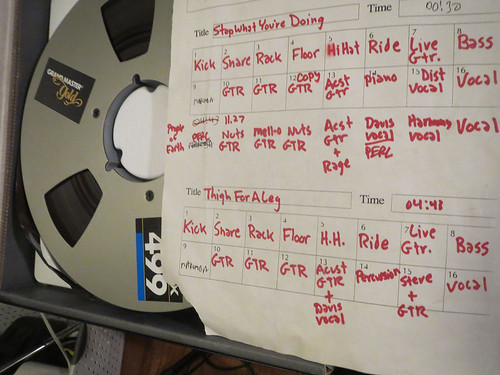
Stop What You're Doing tape.DW: After [our] sobering tour of England for Asleep -- documented in Robert Salsbury's [tour film] "If You Don’t Try, Nothing Ever Happens" -- we agreed the next step would be an album. There was a feeling that if the band broke up without being able to produce even one album, it would render Lorelei a failure. My slacker job doing graphics at a print shop did not pay enough to record at WGNS again. We borrowed ADATs and microphones from my previous band and did most of the tracking ourselves. We recorded at Stephen's house in the woods of North Arlington. Committed to continue working with Geoff, we were able to do select overdubs and mix the album with him. The first session produced "Thigh For A Leg," "Newsprint," "Windmill" and "Stop What You're Doing." Geoff seemed to enjoy the freedom that came with not making a spartan punk rock record. His own projects Senator Flux and New Wet Kojak were very innovative and somewhat before their time. Geoff saw that we were game for complicated sound-effects and unnatural timbres. Nothing was automated, so the effects were done live during the mix, often requiring three sets of hands and 20 minutes of set-up. There was a look of joy on his face when he heard the finished effect. Trying to keep Geoff happy and hiding any major band dysfunction from him was my goal for a time.
MD: We mixed some of the tracks in Avalon Studio in Bethesda, MD, which was well-equipped. I very distinctly recall that Geoff used every single piece of equipment in the place for the climax of "Crimelab." He genuinely seemed to enjoy that we wanted to push what could be accomplished in a studio at that time. He was a willing and enthusiastic collaborator. Geoff also put up with a significant amount of in-band bickering, which I didn't appreciate nearly enough at the time. Thanks, Geoff! I'm not sure why he tolerated us, honestly. I'm not sure I would have had the patience if I were in his shoes.

WGNS was a comfortable place to record, which is crucial. We didn't have to explain ourselves to Geoff. He got what we were about. So in that way it was huge relief to not have to go into a hostile environment and record. It sounds stupid now, but at the time we really were concerned that if we went to Inner Ear, for example, that our record would come out sounding... not like us. Just getting someone to try what you wanted to try in a studio was not a given. There were plenty of places that would have happily taken our money and not helped us much at all. I can't recall a single instance of Geoff discouraging us from trying something. As Stephen mentioned, Geoff was infinitely patient with us and I'm eternally grateful.

DW: Yes, the second set of songs were mixed four months later at Avalon. Geoff had worked out a deal with owner Steve Murphy to use the studio during down time at a discount rate. Matt had borrowed Stephen's 4-track and composed most of the remaining songs in a couple of weeks. The arrangements were done quickly and recorded at Stephen's house while the songs were still fresh. I was barely able to make it through many of them during tracking, as the drum parts were trickier. "Throwaway" has a particularly bizarre, looping beat, but it wasn't jungle-inspired. The band had rejected my initial, simple 2-4 snare. On the spot I came up with the stupidest rhythm I could think of to appease them. The joke was on me, as it sounded perfect. Matt adjusted his part to fit the new syncopations and off it went.

We had finally achieved a unique band voice.Overdubs were done over the next two weeks. The heavily-layered guitars were tri-amped through a Danelectro 3x10 combo, Acoustic 4x12, and Fender Bassman, live-mixed to one track. Looking at the tracking sheet, we had 4-7 tracks reserved for guitar out of the 16 available tracks on the ADATs. The unusual instruments [borrowed] from the Woodlawn [school] instrument room for this session included a double bass, some tuned woodblocks, conga drum and the Gardner family piano. Through a fortunate error, a cheesy orchestral percussion track on "Crimelab" did not get transferred to the 24-track mixing tape at Avalon.
"Crimelab," "Today's Shrug," and "Quiet Staid Debt," were mixed on a Friday night and Saturday at Avalon. My insistence that we dial-down the excesses on "Debt" -- as I wanted prominent, uncompressed, crystal clear, jazz-drums -- well, it sure put me on the bad side of Geoff and the group. I left the session mid-day, after that track was mixed, having worn out my welcome. "Day," "Throwaway," and "Pillar" were mixed without me. This explains why (among other "innovations") the snare drum is panned 100% left on the last track. Snickering aside, when I first heard these mixes I was struck that the final product "didn’t sound like anything else." We had finally achieved a unique band voice. If it was unmarketable, so be it.

CC: How was the experience of recording the album? Fond memories and stand-out experiences?

DW: After transferring the ADAT to Geoff's 1-inch 16-track machine, we did a couple of overdub sessions for the first group of songs. I remember walking into his studio and Matt was flat on his back singing "Windmill" into the bottom of a piano. I knew it was going to be a weird afternoon. Stephen directed me to "help unload the car." We doubled-up on marimba, Matt played a dissected Hammond organ that Geoff was fixing, some group percussion was added, [it was all] totally spontaneous and enjoyable.

SG: I remember very little of the first session, but recall that we took over my house for the tracking, with different instruments set up in different rooms so we could experiment with additions once we got basics down. I remember playing the xylophone parts on "Quiet Staid Debt" on my bathroom floor. In those pre-Pro-Tools days, we spent a lot of time getting takes right or overlooking imperfections for the sake of overall sound or feel. Davis did all the engineering, which was a godsend, and I think Matt and I did overdubs separately with him. We had very little money for the band and almost always lost more than we made per show, so the fact that Davis was a good engineer with lots of his own and borrowed gear was a big advantage. If we had had to pay someone to engineer during the tracking phase, we would not have been able to spend nearly as much time as we did on those songs.

MD: I recall that we did the basic tracks fairly quickly because, again, we were playing often at this time, and so the songs were well-rehearsed. Then we spent forever and a day on overdubs because we were definitely in a "more is more" frame of mind. I can only imagine what we would have created if we had access to a tool like Ableton Live back then. We would have gone ballistic.

Then, vocals were also done fairly quickly. I was being petulant and wanted the vocal delivery to feel "live," or at least sound like one cohesive performance. So I think some of the tracks might even be one take. There was a fair amount of punk attitude in me at this time, and I suppose that's where it shows the most. It was like "Fuck it. Doing it in one take. Not worth the time. Let's mix again!" We did not scrutinize every line like we do now. If there is anything I would change about the record, it would be most of the vocals ("Crimelab" and "Windmill" are okay, but the rest could use some assistance).

GT: My memories of recording this album are almost completely fragmented. Obviously this album was mixed in a pre-ProTools, analog console world, so all of the dynamic and tonal changes, shifting effects, and fader moves were mixed down live by hand to the master tape. When I think back to the sessions, I just remember all of us sitting in close proximity over the board debating mix moves. I joined in these debates willingly. There were a lot of manifestos delivered during the sessions, but I don't recall much stress or hassle. They indulged in constant but good natured goading and ridicule amongst themselves, but that was all really funny and OK. I don't remember eating good food or going out much, [so] we must have been working really hard.

"Inside The Crimelab" still stands as one of my favorite mixing sessions and I’ve had déjà vu back to that day while working with other bands. We built this mix that was so geometrically crisscrossed with delay paths and wobbly instrument treatments that it was completely disorienting even to us during the mix. That song still has that temporal rift effect for me listening back 20 years on, the beat and stereo space just seems so bent by the mixing.

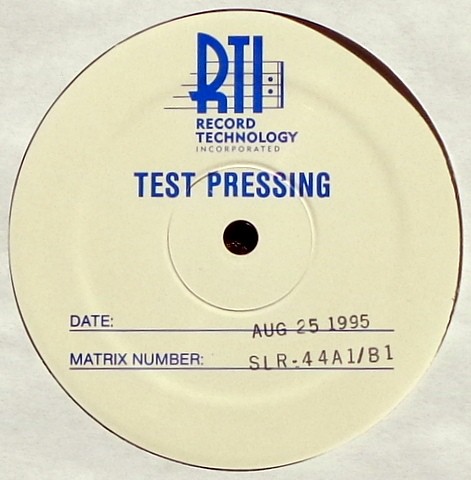
Stove test pressing.Matt would go out into the studio, actually I believe we sent him into the tiny studio restroom, to record these crazy emo-fueled shrieking freakouts, like cathartic vocal outbursts. These were overdubs and were mixed in low during the parts of the songs when the guitars detonated your speakers. I can't remember which songs had these screaming tracks, but on re-listening I'm imagining that I'm hearing them on every song all over the album, which is cool.
The band really acted as their own "producer" and by the recording of Stove they had devised an arrangement wherein each band member assumed the role of executive producer for certain songs. So Davis's opinion (for example) was given the most weight for the recording and mixing direction on that particular song and became like his mini-fiefdom. This worked out really well, brought variety to the album and cut the endless discussions and bullying to a minimum.

CC: There seems to be a lot of less-conventional recording techniques and details within the songs, including very uniquely panned tremolos, delay sounds and distortion effects. What’s going on there? What inspired that? How much of it was a reaction to other things happening at the time?

SG: Partly, this comes from just getting deeper into the recording process and listening much more for production. Davis entered the band already knowing what he was doing in the studio, but Matt and I both came to really understand production through recording in Lorelei, which in turn, changed the way we both listened to records and what we wanted from our own. As cliché as it may be, we had come to see the studio as another member of the band and wanted to put that new member to work. The other factor is that we had way more gear at our disposal than normal in the mixing process, so part of this is just the desire to use all the toys we had.

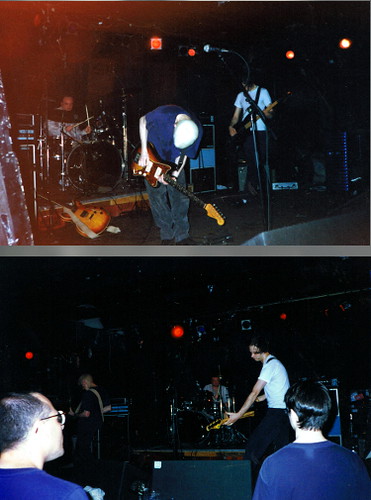
Lorelei, Black Cat, May 1996.DW: Geoff and the band would ponder each of the 16 instrument tracks with a "what can we do to this" attitude. Sometimes, one simple change, such as "Crimelab's" distorted conga drum that Geoff came up with, would redefine the song. This would influence the next effect, and the one after that, until we ran out of patches. The bass guitar was spared any tinkering and had a simple chain throughout. It was recorded direct, then run through a Peavey tube preamp during the mix. Stephen didn't yet have his amazing Acoustic 360 bass "refrigerator" for much of the recording of the album, unfortunately.
MD: I believe Lydia Lunch said something along the lines of "Do anything but start a guitar/bass/drums 3-piece" in regards to the birth of No Wave. I became enamored with the idea that our setup was just done, cooked, over. That resulted in my trying to torture and mutate the guitar sound into something else. Mainly because I could not adequately play anything else, but also because we recognized that mutation in the bands we enjoyed. Look at Slowdive and Seefeel: guitars are certainly there, but they hardly sound like a guitar plugged into a RAT distortion pedal and then into an amp. [T]hat is essentially what most bands around us were doing and I just found that... underwhelming.

But the other thing to mention here is that Lorelei as a three-piece has always had alternately tuned guitars (inspired by Sonic Youth and Bailter Space). "Stale Houses" [from Asleep] is the last song I played a traditional tuning on. I use an open tuning (EAEABE), and that combined with distortion and EQ helps me generate this giant, full sound that lends itself to the effects and manipulation you hear on the record. That sense of experimentation, wanting to have a unique guitar sound, being inspired by noise, controlling and warping of sound is there from the very start and continues through all of our material.

CC: How was the public and critical reception to the album at the time of its release in your view? Was there a tour in support?

SG: We finished mixing the LP in June or July of '94 and it would take over a year for it to come out. Like all of our releases, the time it took to get the record out was a complete killer. These delays were always due to some combo of our incompetence, Slumberland's challenges with money, distribution, etc., and just the way things worked then. My recollection is that the release was essentially ignored. Part of that was our fault. I was already starting my second year of college, so we had really reduced the amount of shows we were playing, plus we had all started other projects to fill in for Lorelei while we couldn't play together. Of course, we didn't have a press or booking agent, and didn't tour for the record because, by then, time was limited and we could never seem to make touring cover our costs. So, it was pretty much destined to fail, but in addition to these self-inflicted factors, I'm sure we faced the normal hostility or disregard we had experienced from most of the US music press. I think The Ropers' All The Time, which was released together with Stove by Slumberland that same week, faced a similar response. While there was some solace in the fact that other great records [of that time] like Bark Psychosis' Hex and Disco Inferno's DI Go Pop... which seemed to be springing from the same well as us, were getting ignored, too, we struggled to understand what to do about it.

CC: So what happened next?

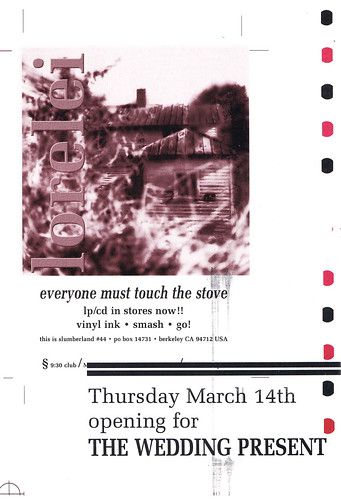
Stove release show with The Wedding Present.SG: We played several shows that summer and fall of 1995 and into the winter with the release of the LP, for which we had a single record-release show in D.C., being pretty sick of the songs by then since they were all more than a year old. We had written a new batch of songs during the summer of '95, most of which we recorded then but didn't mix until 2001, long after we had disbanded. Our last show was in early 1996 in Baltimore at a strip club that had occasional shows. One of my best Lorelei memories was of Matt taking a running leap, guitar-first, into the stripper'’s pole, with the pole working like a giant slide against the fret board. With me back in school in Massachusetts, everyone with new projects, and us with an LP we felt proud of but that failed to register with nearly anyone, it seemed pretty obvious that the time had come to pack it up. Luckily, the end was not acrimonious and, despite lots of challenges between us, I think we all left the band as friends, feeling like we had accomplished something important and with our respect and admiration for each other intact. This was obviously essential to our later work together.
DW: Band activity was next to zero after a brief flurry of shows to promote the album. Tired of dealing with the acrimony, I had adopted a "teamster" persona by this time, contributing only minimally to anything new. We limped along during Stephen's college breaks until Matt decided to move to San Francisco. I was sad to see him go, but relieved the band was over. When I heard the news, I gave out a dramatic 20-second exhale.

MD: We moved apart. I released a Lorelei EP on my label Textilesounds. Then I moved back to the area in 2006 and we made Enterprising Sidewalks, which we hope folks will also find and enjoy over time.

We were there.CC: One of my favorite music articles is Nitsuh Abebe's Pitchfork piece "The Lost Generation," which includes Stove as a defining work of the hard-to-categorize post-rock movement. What are your thoughts regarding that? Do you feel that there was "something in the air" during that time that led to the kind of innovations that he mentions?

MD: It’s nice to be included in the same breath as Disco Inferno, Laika, Pram, Main, etc. I'm not sure I would put Stove at the same level as Laika or Main. They are operating at a different level.

I do rankle a little bit at being put into the "Followers and Fellow Travelers." I don't know which one applies to us, but it feels a bit like the "also rans." I mean, we are American despite not being from Chicago. And if you look at when our record was recorded... there is no way we are a follower of any other American band that you would describe as post-rock. We were recording at the same time as those "Lost Generation" bands. So, for what it is worth, we were there. We were there in that same head space at that same time. You would have had to come to D.C. to see it, but it was here to see.

But in the end we're all quite pleased that the record has found an audience over time. None of the divisions in sound, place, time, [or] label matter as much any longer. At times it was frustrating, but for the most part it was an exciting time to be making music.
It makes sense that a band as forward-thinking as Lorelei would not take much time to pause and consider the nostalgia and historical context of the first chapter of its career. One could argue that this was exemplified quite effectively by its comeback record Enterprising Sidewalks, which further expanded the trio's sounds and philosophies within a contemporary context. This author was also, admittedly, unsure how to cap this interview following their sense that Stove saw little fanfare upon release. It's a shame, to be sure. But, in the weeks following our conversations with the band, a silver lining materialized. Lorelei has just disclosed that -- partially inspired by this interview -- it will play Everyone Must Touch The Stove in its entirety at The Black Cat in Washington, D.C. on Dec. 28. While more details about that special event are forthcoming (and we will be sure to alert you within these electronic pages), it is yet another important step toward ensuring that this special piece of art not only establishes its proper place in the pantheon of innovative rock music, but also bends the ears of a new generation of women and men who -- like the members of Lorelei 20 years ago -- enjoy the thrill of pure discovery. For fans in the market for a copy, Slumberland currently has the CD on sale for a ridiculously reasonable price. If you're not already listening to the record as you read these words, stream the entire set via the YouTube embed below.

Lorelei: Facebook | Interzizzles

October 4, 2015

Today's Hotness: Lilys, Frog, Happy You

Lilys -- Eccsame The Photon Band (1994)

>> Frontier Records announced late Friday that it will release on Halloween (!) the long- and hotly anticipated reissue of Lilys' mid-'90s classic Eccsame The Photon Band (!). Pre-orders for the record, whose original 1994 pressing is extraordinarily rare and has been out of print for 20 years, will begin Tuesday, according to a post on the Frontier Facebook page. Devoted Clicky Clicky readers are quite familiar with the import of Eccsame The Photon Band, in no small part because of Senior Writer Edward Charlton's incredible oral history piece published last December. According to the label, the new pressing of the record features an expanded dynamic range and will be available on "a ghostly shade of pale" vinyl; a "super-limited mail order version" will be pressed to "seafoam splatter" media. We expect we'll have a better idea of the number of pieces of each pressing Tuesday. The track sequence has also been altered in order to better balance the program on each side of the disc, which allowed for a more optimal cut of the master that resulted in the improved dynamic range. Eccsame The Photon Band is Lilys' second LP and last recorded for Spin-Art Records; it was preceded by the equally estimable debut In The Presence Of Nothing and EP A Brief History Of Amazing Letdowns, as well as some singles. We reported here in March 2014 that Lilys mastermind Kurt Heasley intended to reissue those first three recordings; at the time Heasley said he was negotiating with Slumberland Records to release certain records, so the deal with Frontier is a bit of a surprise (although Slumberland *not* reissuing something is not without recent precedent: a very welcome planned reissue of Rocketship's sublime A Certain Smile, A Certain Sadness, originally issued by Slumberland, was at one point said to be coming out via another prominent label, but Rocketship told Exclaim! in August that it will self-release via a Kickstarter campaign the reissue in late 2015 or early 2016). Lilys, in case you don't know, are slated to play selections from its earlier recordings at three amazing east coast shows this week, two at Brooklyn's Baby's All Right and one at Philly's Lithuanian Music Hall. The first two shows are already sold out, and we hope that show of support from fans convinces Heasley to plot additional shows. Los Angeles-based Frontier is a storied punk and indie rock label founded 35 years ago; its catalog includes releases by American Music Club, Circle Jerks and Young Fresh Fellows. Stream all of the original version of Eccsame The Photon Band via the squished YouTube embed below.


>> It's quite satisfying when challenging and worthy music gets rediscovered and reissued. Better still are the times when something is so good that its rise from the deep underground transpires in a matter of months or a few short years. It reinforces a music fan's belief in meritocracy, that something can be so special that no amount of bad luck or insufficient networking can keep it down. All of which calls to mind Audio Antihero's reissue last week of the eponymous debut EP by New York City-based duo Frog. Originally released in January 2013 by the Monkfish label, the EP is gaining exposure to new audiences via London-based (for a little while longer, anyway) Audio Antihero; the label previously released the group's terrific, sepia-toned Kind Of Blah LP in May [boing!]. Appraising the adventurous EP in the context of that long-player limns why the imprint signed them in the first place. Frog's raw and emotional music in places and spaces between seems to have no clear precedent. Indeed, Frog is singular in its presentation and production, having arrived seemingly fully formed like Athena from the head of Zeus. The ringing guitar strings of second track "Arkansas" are like a siren's call, and the song glows with hissy reverb. Later, the tune's pounding stop-start dynamics hit so viscerally that one can nearly see the sound waves bouncing off of the concrete walls in the negative space. Dan Bateman's vocals hit at a base level, his croaks, yelps and shrieks echoing those of folk and blues musicians of a bygone era. Frog's music seems to draw from a shared universal subconsciousness, but touts a modern sense of humor and irony. Further, the looping, detuned acoustic guitar and Tom White's percussion place an avant-garde frame around the songs, suggesting a more manic, deranged millennial John Fahey. Taken all together, the appeal is perhaps hard to define, but that makes it perhaps even more appealing. And that, ultimately, is what makes Frog so important. The epic "Nancy Kerrigan" goes one step further in hammering straight to the heart. "Choked down a Claritin / thought back to Oregon / where she wore her cardigan / just like Nancy Kerrigan / when they broke her legs / over your frosted flakes," sings Bateman as sweetly as he can muster. Such observations, as devastating as they are surreal, provide a great glimpse into the shifting, magical world of Frog. There everything is blurry, and the range of human experiences accretes to some sum of elated confusion. Order the EP on cassette (a limited edition of 50 green cassettes) or as a digital download from the band right here, and stream the entire short set via the embed below. -- Edward Charlton


>> We last covered New York-based dream-pop septet Happy You about a year ago, noting that its debut Giggle delivered key tracks whose pitch-perfect melodies were "mainlined via breathy vocals, ample fuzz and ethereal feedback." The crafty, upbeat exuberance of the self-released collection was a welcome surprise, and we're pleased to see the band return so quickly with similarly appealing music on EP1; the short set was issued as a digital download early last month and is now available for any price via the act's Bandcamp. The three-song collection evidences Happy You readily embracing the more downbeat, melancholy aspects of its sound. On each track, the band establishes a singular melodic environment that plays host well-timed earworms that strike during the choruses. Middle track "Unlucky" commences with a nifty, jaunty Brit-pop chord progression chased by simple, string-bent falsettos that tug at listeners' heartstrings. "We Could Be Friends" lurches with distorted, chugging palm mutes and spare snare hits but is lifted up by the titular plea in the chorus; textured fuzz effects course through the stereo channels. Subtle standout "Not Worried" leads the EP and succeeds via soft whispers and spiraling, clean guitar arpeggios that find Happy You ably setting off mood and atmosphere in a manner consistent with slowcore masters Low (whose own new record is stirring) and Bedhead. Here, Happy You's quiet verses -- with vocals that recall Elliot Smith at his most starry-eyed -– precipitate a chorus so lilting and quick one can almost miss it. The ironic ache during the last word of the line "It's okay I'm not worried anymore," not only illuminates another dimension of the act's promising songwriting, but suggests a satisfying variety of output continues to be a calling card for the rock combo. Download EP1 for any price here, and stream the entire EP via the embed below. -- Edward Charlton


September 15, 2015

Clicky Clicky Presents: A Very Clicky Clicky September with Dæphne, Elizabeth Colour Wheel and Beeef | O'Brien's Pub, Allston | 16 Sept.

Clicky Clicky Presents: A Very Clicky Clicky September with Dæphne, Elizabeth Colour Wheel and Beeef | O'Brien's Pub, Allston | 16 Sept.

In case you've not yet heard, yr friends at Clicky Clicky are putting on some rock shows in glamorous Allston Rock City™ this fall and into the new year. The first is tomorrow night, when rock fans who assemble at O'Brien's Pub can catch an evening of now sounds from jangle-mongers Beeef, stormy shoegazers Elizabeth Colour Wheel, and the pensive dream-pop purveyors Dæphne.

Beeef, a new-ish act that counts among its number journalist Perry Eaton (Allston Pudding, Boston.com), released unto the Interwebs last spring a strong, eponymous EP that paired irrefutably catchy surf-styled guitar licks with Mr. Eaton's lively paeans to Boston living. While all four numbers on Beeef are winners, the one jam to rule them all is "Dogshit Paradise." Here the band steers an efficient and sturdy bass line through an extended workout as Eaton waxes on the mundanity of morning commutes and dirty student domiciles.

Attentive readers will recall our previously spreading the good news far and wide about Elizabeth Colour Wheel, and not just because their name totes references blog forever faves Lilys. There was this piece, and then there was this piece; good times. Having seen the quintet rock basements and Berklee parties within and without Allston, we can confirm that its live set can be transcendent, and so we are pleased to also have Elizabeth Colour Wheel on the bill tomorrow.

As with ECW, we dubbed Dæphne a Boston band to watch based purely on the strength of a formidable four-track demo, this one surfacing late last year. We went so far as to deem their tune "Driving Down a Country Highway Blasting Weezer" one of the best of 2014. Dæphne is hatching plans to ditch the best coast for a life anew out west and we will wish them great success in their future endeavors when the time comes. But in the meantime there is rock to be rocked (not to mention, apparently, a debut LP to release), and we are pleased to host the quartet for what may or may not amount to one of its last gigs in town.

There might be an additional detail or two at this Facebook event page, but that is largely the size of it. We beseech you to come early tomorrow, maybe enjoy a beer or two if you so choose, and then of course stay late. In that exact order. Also bring earplugs. If you've not yet memorized the three EPs referenced supra, we have embedded them below for your listening pleasure. -- Dillon Riley


June 20, 2015

Today's Hotness: Treasures Of Mexico, Hisoft, Tadoma

The Treasures Of Mexico -- Holding Pattern(crop)

>> The folks at Shelflife Records can certainly pick a single, which are words we feel like we've written here before, but if that's true it only underscores that the label knows when it hears a hit. The most recent example is "Stars," the masterful and endlessly delightful preview track from the recently issued debut set Holding Pattern from The Treasures Of Mexico. The Chatham, England-based band is the songwriting vehicle of Mark Matthews, who is joined in The Treasures Of Mexico with his former The Dentists bandmate Bob Collins as well as drummer Russ Baxter (who, incidentally, also serves time detonating the cans for an act called Secret Affair). "Stars" is a Grade A guitar-pop gem with subtle vocal harmonies and tasteful synth support that will certainly strike a chord (ha) with fans of things excellent such as Teenage Fanclub's "Star Sign" (speaking of stars) or RIDE's "Taste." While the closing section of the song is all "yeah yeah yeahs" and bashes in an exhilarating way, The Treasures Of Mexico sound is perhaps not quite as aggressive and saturated as those aforementioned tunes, and all of the trio's Holding Pattern harkens, sonically, back to pre-grunge dynamics -- meaning the aggression never gets too aggressive, the distortions never completely white out the aural field. That more subdued dynamic is present across Holding Pattern -- even the uptempo, sugary rush of "Stars" is a bit of an outlier on the set -- but that allows the songs on the record to breathe in a very pleasing way that recalls The House Of Love or The Connells. Or, you know, The Dentists. The press materials from Shelflife indicate all of the former Dentists guys have new projects and collaborate in various combinations and to certain extents, so there is a lot of activity for fans to track. More germane to this conversation is the fact that a follow-up to Holding Pattern is already in the offing. For those unfamiliar, The Dentists were '80s greats responsible for such bangers as "Eyes" and the terrific LPs If All The Flies Were One Fly and Some People Are On The Pitch They Think It's All Over It Is Now. Holding Pattern was released by Shelflife June 2 as a digital download, which you can purchase right here.


>> We are compelled to recount the story of The Low Numbers and Hisoft on the rare occasion that there is a new (or sad) development, but those occasions have been exceedingly rare in the last decade, so let's re-cap. Back in the later '90s when we lived in Philadelphia, we were minding our own business one evening at a rock show at the then-relatively-new Balcony, which was and remains upstairs at The Trocadero. Opening or in the middle of a bill was a band that blew us away, a band that was having a perfect night, The Low Numbers, who had these incredible new wave-damaged, Tuetonic songs and a strong look. Information about the band was hard to come by, and then we moved away, and only through the magic of the Internets and a kind soul on MySpace were we able to eventually get our hands on some tracks and learn more about the band. Some of what we learned: members of The Low Numbers had a new combo called Hisoft, and that certain of these members had been in an iteration of our beloved Lilys in the early '00s, and then Hisoft released its awesome Amateur EP in 2006. And then... nothing. Nothing, that is, until now. A tip Thursday pointed us to the new Hisoft jam "State Police," which is embedded below, and which was posted to Soundcloud earlier this week. "State Police" carries all the trademarks of a great Hisoft jam: enticing melodies, smoothed-out vibes and fronter Gerhardt Koerner's even vocals. But the song is also a touch noisier and dense than the tunes on the band's aforementioned EP, with distorted guitar lurking deep in the mix, underneath waves of spiraling lead that undulate like light through water. We're very hopeful "State Police" is a harbinger of another release from Hisoft, as we think nine years is plenty long to wait between releases, yeah? We shall keep you apprised. Stream the new tune via the Soundcloud embed below and stream Amateur via Spotify right here.


>> Sticking with Philadelphia, we were very pleased to get a ping about a new collection of recordings from visionary electronic producer Joe Patitucci, who operates under the nomme de guerre Tadoma and also co-founded the next-level digital label Data Garden. It's been two years since we last heard from Tadoma, but out of the blue Tuesday Bandcamp hipped us to the existence of a new set titled Journeys Through Time. The four-song, 30-ish minute collection is comprised of songs improvised and recorded live in August 2012 at Philadelphia's scene-making Johnny Brenda's venue. According to Mr. Patitucci, the live performance was inspired by a meditation tape titled Journeys Through Time that he received from his Data Garden co-founder -- and former Diagram bandmate -- Alex Tyson. "All tracks were performed on-the-fly, without pre-programmed sequences or beats." The music is engrossing, blending thick and airy synth tones, spare beats, found audio, and analog and digital delays into a compelling soundworld that begins and ends much more quickly than the half-hour run time would have you believe. Fans of the popular Boards Of Canada records will find a lot to like here, but frankly we are equally impressed by the fact that the music was improvised as we are with the music itself. Journeys Through Time is available as a paywhutchyalike download from Bandcamp right here. Tadoma's prior release, unleashed in 2013, was the terrific demos collection Nascent Zones, which remains available at Bandcamp and which we wrote about right here. Stream all of Journeys Through Time via the embed below.


March 10, 2015

Premiere: Boston Shoegaze Upstarts Elizabeth Colour Wheel's Stormy, Eponymous EP

Elizabeth Colour Wheel -- Elizabeth Colour Wheel

From our vantage here standing on the beach of Boston indie rock (shivering), we see out in the middle distance a new wave of shoegaze forming and heading toward shore. In a way it's not a moment too soon, as the city has had to say goodbye in the past year to stalwart acts -- Clicky Clicky faves all -- Soccer Mom, ambient punks Young Adults, and perhaps (perhaps) even The Hush Now. But the new wave is breaking, and its most promising sounds are presently being emitted by the upstart quintet Elizabeth Colour Wheel

Those finely attuned to Clicky Clicky's affinities will immediately recognize that band name as the title to one of the best songs on the debut LP from our much, much beloved Lilys. So one might argue that Elizabeth Colour Wheel's music could sound like broken glass sliding across the bottom of a cardboard box and we'd still love it. But two solid digital singles in the last eight months proved that the band -- fronter/fiddler Adessa Campbell; multi-instrumentalist Alec Jackson; bassist Billy Cunningham; guitarist Emmett Palaima; and drummer Nate Patsfall -- have the goods, and we are very pleased to be able to premiere for you today ECW's eponymous first EP.

The four-song collection leads with the thunderous "Turbulence," whose opening chug and grungy descent belies the serene verses that follow, and whose moody darkness recalls the work of erstwhile Charlottesville, VA 'gazers Manorlady. "Out Of," which was separately released to the wilds of the Internets both last week to tout the coming EP and as the digital b-side to Elizabeth Colour Wheel's first single, is immediate, recklessly paced and illuminates the five-piece's post-punk edge. The tune also implements what may be the most rocking use of violin in Boston indie music since the days of the late great Dambuilders, courtesy of Ms. Campbell. However, Campbell's assured alto is an even stronger focal point of the fledgling act's music. Her dreamiest vocal is the placid zen center of the relatively jaunty rocker "Lucid," which alternates floating verses and thrashing sections and perhaps most convincingly echoes the influence of the aforementioned Lilys' LP In The Presence Of Nothing (which we're still hoping will be re-released soon). Elizabeth Colour Wheel's enigmatically titled "23" introduces brief vocal harmonies, but the true highlight is the spine-tingling, early Flaming Lips-styled psychedelic freakout in the tune's fifth minute, where Ms. Campbell's unhinged screams send the song reeling.

As referenced above, the quintet released "Out Of" as a single last week, and it is crucial you hit this link and grab it because the virtual b-side "Sugar Cubee" is adventurous, blissful and terrific, and (shockingly) does not appear on the EP. Elizabeth Colour Wheel's next show is in Boston March 27 at an undisclosed location; ping the band or ask a punk for the 10-20. And now, we invite you to listen to Elizabeth Colour Wheel.

Elizabeth Colour Wheel: Bandcamp | Facebook | Soundcloud

December 18, 2014

I WILL WRITE A MYSTERY FOR YOU TO SOLVE: An Oral History of Lilys' Astonishing Eccsame The Photon Band

Lilys - Eccsame The Photon Band

|| by EDWARD CHARLTON || [updated] This month marks the 20th anniversary of the release of Lilys' powerful and mysterious Eccsame The Photon Band, a unique collection even among the oeuvre of Kurt Heasley, the band's notably restless songwriter and only constant member. For our money, it is certainly one of the most engaging -- if underheard -- indie rock albums of the '90s. Like a lot of great music, the album's creation owes a debt to that rare and singular cocktail of youth: chance, environment and a positive open-mindedness shared among the four men who created it. "Behold and open to the light," translates the title -- a sentiment that seems to have guided the principals behind it from the foursome's very first minute together.

As we listened to Mr. Heasley, drummer Harry Evans and producer Rich Costey tell the story of the album, we found that Eccsame The Photon Band was a roughly month-long flash of exhaustive inspiration -- a gnawing, melodic, experimental expression that sprang into being so suddenly it felt as if it were over nearly as soon as it had begun. Despite that, the music and production contained therein has continued to resonate with those involved, as well as with a fanatical cult following attracted to its atypical dream-pop charms. Among those, cryptic lyrics, crestfallen textures, occasional moments of loud guitar and a spiritual and devastating silence all continue to stun. To mark the aforementioned anniversary, Clicky Clicky spoke with Mssrs. Heasley, Evans and Costey about the summer of 1994, discussing a wide-range of topics including the philosophies, drum sounds and even the studio weeping that birthed a rare and unique aural document.

"I can't deviate out of the moment -- you get into the game of expectations, then you get into the game of disappointment," Heasley tells Clicky Clicky from his present home in Los Angeles. The sentiment arrives early in our conversation about the album, and it quickly becomes apparent that Eccsame was (and is) something of a mission statement for just that mentality.

The genesis of that notion came two years prior to the creation of Eccsame, spurred by some of the negative reception to Lilys' magnificent and now-legendary 1992 shoegaze debut full-length, In The Presence of Nothing. "I had no idea people would listen to this," he says of that collection, "Much less feel so strongly [about it]. It was ultimately just a group of friends making something in a basement for a few hours. I took it as the most extreme feelings [from some in the scene] of being left out of their own party."

Disappointed, but confident in the power of his on-the-fly approach, Heasley began to see how the band's process might function in the face of more standard and predictable musical norms.

In the wake of the flawless, power-pop injected A Brief History of Amazing Letdowns EP that was released the next year, Heasley made some life changes that would further create the conditions for an experiment like Eccsame. "I had new urban experiences because I had moved from Lancaster [Pennsylvania] into Philadelphia proper, living with some incredible people," he said, "Joey Sweeney let me sleep on his girlfriend's couch for weeks. It was just this ongoing live/work/play space and the amount of literature, cinema and old records that I was being turned on to for the first time was great. There, I had the feeling of going from 22 to 23, and the prevailing wisdom that 23 is the best worst year of your life. Slowly, there were responsibilities creeping in and the realization that 'this is not a dress rehearsal.'"

At the same time, the alternative/grunge zeitgeist of the prior several years was beginning to breed bad vibes. Not only did Kurt Cobain's death in the spring of '94 mark a dramatic shift in the mood of rock culture, but recent records by Talk Talk's Mark Hollis and Pale Saint's Ian Masters alerted Heasley to the loss of fidelity and subtlety in those buzzing times. "Those gated drums in '92," he exclaimed with a sigh. A trip to a Broadway production later that year would also make an impression on him. "Listening to what a five-piece pit orchestra could do literally blew me apart. Working from that level where everyone plays their part and has mastered themselves revealed a new world."

In the winter following the release of A Brief History Of Amazing Letdowns, Heasley began sketching out some fresh ideas. Those recordings would ultimately be released on 2000's Tigerstyle Records split with Aspera Ad Astra. As a historical document, the four songs reveal a remarkably clear vision of the minimal, dreamy sound that would ultimately define Eccsame -- what Stylus Magazine writer Andrew Unterberger described as "Not influenced by shoegazing as a genre, but rather as a principle."

It was time to enter the studio.

That summer, spinART Records agreed to provide five weeks of time at Studio .45, a converted turn-of-the-century Colt firearms factory in Hartford, Connecticut. It was also at that point that Harry Evans of power-pop standouts Poole and producer Rich Costey entered the picture.

Evans had known Heasley for a few years by '94, and had played on every Lilys release beginning with Presence. The two first met due to being physically larger guys in the scene who looked similar and both showed up at the same music store. "I was shopping there and somebody called me (Kurt's nickname) 'Wally' and I was like, 'no, I'm Harry!'" Evan says, laughing, "We happened to be at the store at the same time eventually and recognized each other due to that mix up. We started hanging out and eventually he asked me if I wanted to play drums for him. He played me "February Fourteenth" and I was like 'What the hell! Of course!'"

Following the release of A Brief History and the subsequent shows for that record, Heasley approached him with an idea. "Kurt was like, 'I want to make a record, and I want it to just be you and me.' He booked a lot of time. I hadn't heard any of the material, but he said we could learn it in the studio. Having faith in anything Kurt does, I agreed immediately," Evans reflects. That summer, the two loaded up a van with gear and made the trek to Hartford. There, they met producer Costey and engineer Mike Deming. Costey had been chosen based on work he had done with scene compatriots The Swirlies.

"I was doing a few records for spinART around that time, and at some point I ended up on a phone call with Kurt," Costey remembers, “He was an interesting character on the phone, and I still remember my first phone call with him -- rambling on and on whilst puffing on cigarettes the whole time. We must have connected somewhat. I liked the psychedelic aspect to [Lilys'] music a lot, based only on the album they had out the year before, and given the general monochromatic, conservative landscape of American grunge at that time, Kurt's music struck me as being a total technicolor garden. I had worked with The Swirlies, whom I think he begrudgingly respected, but those two bands were actually quite different in approach. The Swirlies were fighting their own limitations whereas Kurt never saw or felt any limitations at all... [He] was inventing his own landscape."

Setting up on the first day, Heasley and Evans filled out Studio .45's large, single-room with their instruments. Beginning at dusk, the duo at first had a hard time connecting. "On the first day we set everything up, Kurt was going to guide me through the songs," said Evans, "We started recording really late, but it was just not clicking. The first song we were working on was "FBI And Their Toronto Transmitters." Eventually I got super frustrated. While I had told myself initially that I was going to be really sober and work as hard as possible during the session, we ultimately took a break and I got REALLY high. We went back in and nailed it in the first take. I was like, "Aw, this is really disappointing (chuckles)."

"For the first 10 days Costey probably didn't think they were songs!," Heasley added.

After these initial hurdles, the duo settled into a groove, with Evans adapting to Heasley's ideas and advice regarding drumming. "There was a methodical thought to the way that the fills were put together. He really helped me to curb my ego, and I was willing to say 'I will listen to your ideas.' Ultimately, they proved to be great ideas. I had to be open," Evans remembered.

The songs gradually came together over the ensuing weeks, and many of the album's iconic textures began to take focus -- specifically, the massive, roomy drum sound that many Eccsame cultists rave about.

Costey recited the technical details for accomplishing this with aplomb. "The drum sound was a combination of several things: the hard, open space that the live room at Studio .45 presented; a precisely placed AKG 414 placed in between the kick and snare drums, aimed at the floor... heavily compressed with a Spectrasonics 610 compressor; and also the minimal and incredibly powerful, tasteful playing of Harry Evans. Listening to it today, it seems a study in how a drummer should play to the sound presented to him or her, as opposed to the other way around."

Mike Deming is also credited by the other three as being instrumental to the presentation. "I’ve got to credit him for that drum sound. He was a twisted, evil audio genius. He was crazy and so into what he did on a micro level," said Evans, referencing at least obliquely the album's often overwhelming negative space, best heard in the long, faraway intro and subsequent eruption of focus on "The Turtle Which Died Before Knowing."

Other subtle, genius moments were entirely due to chance. On some songs, different takes were mixed together and the resulting edits created things that thrilled everyone in the control room. "A couple of those moments where the vibrato on the guitar shifts patterns -- we couldn't have planned that, but that's the thing! We were open not necessarily to it being correct, but to it being right for what it was," Heasley said.

Other moments betrayed the quieter vibe with sheer power. "The Hermit Crab," "Kodiak (Reprise)" and "Radiotricity" all rock in places, despite being composed mostly with clean, bass string strums. Costey explains that the amping of the guitars went a long way in lending huge power to a quiet source, "One simple thing Kurt was doing with his guitar sounds at the time was to run two different tremolo pedals into two different amps," he said, "It's really simple, of course, but it made for an off-kilter, drunken, gurgling guitar sound that completely shaped the feel of the record."

Elsewhere, such as on the down-tempo lullaby-pop of "Day Of The Monkey," Costey sampled Evans' drums to create a hypnotic loop, later adding room recordings of him playing along to himself to add to the overall sonic fantasia.

The collaborative aspect between the four also played a key role in the shape of the album. "He had done Swirlies records," said Heasley of Costey, "So I was like 'throw me whatever note you think should be in this melody.' I think you can only do so many records where that special and fun ability exists."

As the sessions wrapped up, it was also clear that the process of achieving the album's menthol-cool psychedelia had thoroughly exhausted Heasley. Much of the tracking came down to the wire, and many of his vocal parts had to be recorded at the end in a prolonged series of takes.

"I spent the final 18 hours of tracking in the vocal booth," Heasley recalled, "By the time we were working on "Hubble" I was completely drained by the process, from all these different drives that went into the album. You can hear me crying at one point. I couldn't even stand, I was propped in a chair." Costey, aware of the strain and the reality of the moment, let the tape run. What followed was personal, uncomfortable and brilliant.

It's apparent when Heasley talks about "Hubble" that the song is special to him, referring to it as the closing sequence of the booster of the space shuttle falling to Earth. More importantly, it's a fitting end to the hyper-productive sessions that produced a collection of songs that were not only spacey-sounding, but physically so. Costey took the tapes to Water Studios in Hoboken, New Jersey and Philip Glass' The Looking Glass studio in New York for the rest of the post-production. There, he added many of the synth textures and final mixing details. SpinART had the album out by the end of the year.

And then... it was over.

"Kurt moved to California, I believe, shortly after we made the record," said Evan. "I feel like nobody really got it, understood it or appreciated it when it came out." No shows were played to support the release, which somehow makes the recording all the more mythical.

Within a year, Heasley transformed Lilys into the mod-rock powerhouse that would define the next phase of the group, with songs like "Nanny In Manhattan" (a version of which was recorded during the Eccsame sessions but lost with the master tapes) broadening the exposure of the band and leading to a record deal with Sire. Evans would continue a successful run as the frontman of indie pop savants Poole, an act that also recorded for spinART. Lastly, Costey would use his resume with bands from the East Coast dream-pop and 'gaze scene to begin work in Los Angeles, eventually engineering and producing a seemingly endless list of big-name musical personalities including Sigur Ros, Fiona Apple, Nine Inch Nails, Muse, Foo Fighters and self-professed Swirlies fans Mew, among many others.

Despite the very abrupt end to the Eccsame phase of Lilys, and the scattering of its participants, it is apparent that the three remember the time in the studio fondly, and all have an unshakable faith in the final product.

"I felt pretty good about the album when we had finished it," Costey adds, "It seemed fresh, inventive, and colorful. Kurt's writing isn't miles away from Syd Barrett territory, but as opposed to Syd, Kurt's lyrics were open and personal. I had hoped that it would be recognized a bit more for what I felt was something pretty unique at that time: Psychedelic indie with heavy fuzz, samplers, and 808s -- but it seemed to never really get the attention it deserved. Kurt went straight to The Kinks' Muswell Hillbillies [as the template] for his next album and finally had his talent recognized, but in the process it had always felt to me that Eccsame was just overlooked."

Most importantly though, the sense of trust between the album's principals appears to be the most defining and memorable part of the era. Listening to Evans and Heasley, in particular, speak of their relationship during that time illuminates a connection between kindred souls, a pair determined to create and build as a unit.

"I could never have that kind of naive trust again. You basically get [it] once." Heasley added somberly.

At times during this reflection, it shows that both might harbor some desire to work together again. In the age of '90s dream-pop band reunions, with acts including Slowdive, Medicine, Ride and My Bloody Valentine thrilling audiences once more, it wouldn't be seem that unusual for an influential lineup of Lilys to get back together, hopefully even for new music.

"He knows that I'm willing to work with him anywhere, anytime. At the drop of a hat, I'm in," Evans proclaimed, ever the dedicated bandmate, ignoring the thousands of miles between them.

That possibility is a dream for this blog, at least, and it is dreaming big that brought together those men in 1994 -- hedging their bets on chance and understanding. But big dreams can live on in unusual ways, and funny enough, it is because of the Lilys that this scribe first spoke to this editor at Clicky Clicky some five years ago. And, because of all of that, it has ultimately brought you, dear reader, to what may not yet be the final chapter in the story of a very special and evolving piece of art.

"Behold and open to the light."

Currently, Eccsame The Photon Band is out of print (spinART folded in 2007), and both CD and vinyl copies command steep prices in the collectors' market. Heasley has been negotiating the reissue of In The Presence Of Nothing and two other unspecified titles, and also the release of new music, according to news we reported here in March. Through the murky magic of the Internet, you can listen to selections from Eccsame via the YouTube playlist posted below. -- Edward Charlton


SELECTED PREVIOUS COVERAGE:
In Bloom: Lilys Poised For Massive Resurgence; New Music, Reissues And Live Performances Planned
That Was The Show That Was: Lilys with Prefab Messiahs | Lilypad | 15 June
That Was The Show That Was: Lilys | Lilypad | 25 May
A N D I F O R G O T A L O N G T I M E A G O H O W Y O U F E E L : ten now acts perform selections from the early recordings of Lilys, 1991-1995
20: Lilys | In The Presence Of Nothing
Today's Hotness: Lilys
YouTube Rodeo: Lilys' Amazing "YCJCYAQFTD," "A Nanny In Manhattan," "Baby's A Dealer"
Footage: Lorelei Cover Lilys' "February 14th" | Slumberland 20th Anniversary
Today's Hotness: Lilys
750 Times The Same Song: It's All About The Lilys