Showing posts with label New Order. Show all posts

November 4, 2015

Stop What You're Doing: How Lorelei Transcended Its Influences And Produced The Undersung, Prescient Post-Rock Classic Everyone Must Touch The Stove

Stop What You're Doing: How Lorelei Saw Beyond Itself and Produced The Undersung, Prescient Post-Rock Classic Everyone Must Touch The Stove

[By Edward Charlton / UPDATED] Time, place and personnel. These three elements proved to be everything for Lorelei, a misfit trio of adventurous indie musicians whose debut long-playing album, Everyone Must Touch The Stove, turned 20 years old in September.

The time was the early 1990s, when the so-called alternative ethos loomed over both the musical underground and overground, experiencing its first identity crisis when grunge penetrated the purview of high school dances and topped the pop charts. The place was Washington, D.C., where the narrowly realized punk idealism of the '80s had ebbed, giving way to a fertile and diverse scene whose possibilities seemed limitless in the minds of many of its players. And so it was with the band; Lorelei was a challenged and ever-changing project, which -- through a series of fortunate and formative experiences -- chanced upon the ideal combination of the three aforementioned factors to create an expansive, experimental and startlingly prescient indie rock album. Indeed, the long-player Everyone Must Touch The Stove foretold much of the coming post-rock movement, whose influence helped shape the next two decades of sub-popular independent music. Lorelei continues to perform live occasionally, and is poised to announce at least one special performance for the end of 2015. More about that below.

Following a series of terrific compilation tracks, singles and the beautiful Asleep EP -- recordings whose sounds closely tracked to the group's rapid development and lineup changes -- Lorelei committed 10 of its most refined and experimental pieces to tape at home and Geoff Turner's WGNS studios in Arlington, Virginia in 1994. Released a year later by the esteemed Slumberland Records, Stove was Lorelei's final statement until a 2006 reunion precipitated the 2012 comeback LP Enterprising Sidewalks. Slumberland calls Stove "a brave album, blending together a vast array of sounds into a bold statement of the possibilities of pop and rock, heading off in a hundred different directions at the same time, but still remaining a cohesive whole." Mr. Turner below positively assesses the record as "unyielding." Clicky Clicky does not disagree on either count.
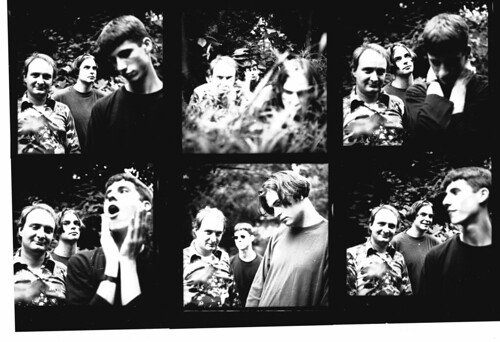
Everyone Must Touch The Stove contact sheet.Opener "Today's Shrug" sets the tone with shifting melodies, guitar feedback and the act's endlessly creative and sturdy rhythm section, all of which underpin evocative lyrics and uniquely emotive vocals. Throughout the album, highly technical, stereo guitar effects workouts ("Thigh For A Leg," "Throwaway," and the otherworldly centerpiece "Inside The Crimelab") mingle with power-pop rockers ("Newsprint," "Stop What You’re Doing") and polyrhythmic acoustic instrumentals and interludes ("Day," "Windmill") for a curiously wandering and dreamy listen that seems to exist both within and without the era in which it was created. Even now, Stove's terrific songwriting and artful textures intrigue new fans discovering the record for the first time. While it is Clicky Clicky's experience that we rarely encounter a musician that says they were directly influenced by the band (even Allmusic.com paradoxically has nothing to say about the record), it is pretty much the rule that every musician to whom we have introduced Everyone Must Touch The Stove finds it inspiring. To loosely paraphrase one of them, the time is right to reintroduce this exceptional record to people and give it the critical appraisal it deserves.

We had the honor of speaking this fall with Lorelei drummer Davis White, guitarist/singer Matthew Dingee and bassist Stephen Gardner, as well as revered engineer and producer Geoff Turner, about the creation of Stove, their thoughts on the Mid-Atlantic indie-pop scene of the '90s, and the legacy of the record today. Each of them gave highly considerate and detailed answers to our questions, for which we are very grateful. Our exchanges below transport us back to that hopeful, youthful and, above all else, inventive time two decades gone. Press play on the record and join us on our deep dive into Lorelei's 1995 classic, Everyone Must Touch The Stove.
Clicky Clicky: Tell us about how the band first began.

Davis White (drummer): Stephen and I met at an American University dorm party, in September of 1990. Our bands had played a show together earlier that summer and he recognized me. We hatched a plan to start a band faintly resembling Charlatans UK after Christmas break. Stephen was 14 and I was 29. Neither of us really belonged at such a party, so [it was] quite an unlikely meeting. For brevity and to avoid distraction, we will mostly ignore the myriad early line-ups [of Lorelei] from January to September of 1991 involving (original guitarist) Dave Cerf, Stephen and I. That is a story for another time, and I don't want to short-change all the other fine folks we played with. This period produced our first single "The Bitter Air," so it wasn't a total washout. But I would say Lorelei, as we know it today, began with this post-note from Stephen's mom, "Matt from the Lilys called." It has been folded away in my Boss tuner since that day in August 1991.

The post-it note that started it all.Matthew Dingee (guitarist/vocalist): I guess I shouldn't be shocked that Davis has this note. He and Stephen are excellent documentarians. I will say I was definitely formerly of Lilys by that point. [Lilys mastermind] Kurt [Heasley] had been squatting at my apartment while I was in Lilys, which was an awesome arrangement as far as I was concerned (my parents were less enthused). I learned a ton from him and enjoyed it. But that arrangement came to an end, and shortly after I was told by Archie [Moore, of Velocity Girl] that he was my replacement in Lilys. I only mention this because I cannot recall if it was Archie, Kurt, or Mike Schulman who suggested I call Stephen. Regardless, thanks to whomever pushed me in that direction.

DW: Stephen and I had seen Matt a couple of times in Lilys and enjoyed his playing style, recognizing a major The Cure influence. We were ecstatic when he expressed interest in joining us. Dave had moved away to attend his first year at CalArts. So Matt was thrust into playing our legacy material as the replacement guitarist. We played like this for a couple of months, but the old set wasn't sounding very good. By November we had whittled down to a more productive and satisfying trio. We quickly worked up a new set based around songs Matt had written prior to meeting us. The trio first played a fall concert prom at Stephen's high school. To illustrate the timeline, Nirvana's "Smells Like Teen Spirit" was riding high on the top of the charts. Two or three of the high school bands covered the song that night. Matt observed that it was going to be "a hard fight for us to compete with all this grunge."

Stephen Gardner (bassist): I got an early start with music through my older sisters and the typical mid-'80s entry point of The Smiths, The Cure, New Order, etc., choosing to learn bass because one of them said it was "cooler than guitar." I followed them straight to the Dischord scene. People always ask us about being from D.C., and while the music [there] had a huge impact on me, it was the fact that there was this totally youth-organized, completely accessible, all-ages environment of kids doing their own thing that was the biggest influence and created a sense of perpetual possibility. Anyway, by 1990 I had played in a few short-lived hardcore bands and had a show with one of Davis's many other bands, Repercussion, who I had seen several times by then. He, sounding like Joe Jackson and playing a mandolin in a band that was somewhere between thrash and early [Elvis] Costello, was hard to forget. A friend and well-known D.C. photographer, Colby Caldwell, whose photos are on most of the Lorelei records, had gotten me into 4AD stuff and my discovery of a succession of EPs from Lush, Pale Saints, Ride, The Boo Radleys, Slowdive and My Bloody Valentine shifted my whole perception about what was possible -- that there was maybe a way to combine the vitality of Rites Of Spring with the harmonic complexity of The Smiths, all wrapped up in this new depth, texture and space I was hearing on these records. [I was] [c]onvinced I needed to start a new band to make that happen...

CC: What was your experience with the people and places of the Mid-Atlantic and D.C. indie-pop/rock scene from 1990-1996? How do you view that era now? In the context of the label's roster and also in hindsight, Lorelei "makes sense," but at the time did you feel like what you were setting out to do fit well within the regional scene, or did you feel like Lorelei was doing something new and alien?

MD: To us the regional scene boiled down to Dischord and then the labels behind Pop Losers: Slumberland, Teen Beat, and Simple Machines. Within that scene, I was staunchly pro-Slumberland and fairly anti- everything else. Slumberland grew into a tight knit family of friends. Mike and I listened to a ton of records together around this time. It was quite an education. It's hard for me to put into words just how important the relationships built at that time are to me. Slumberland is my tribe and I'm still happy they haven't kicked me to the curb.

Lorelei, practice, 1990s.Lorelei as a three-piece didn't start off too far afield from Lilys, though much less refined. We played with bands on other local labels and enjoyed that. But fitting in was the last thing I wanted to do. To Mike's credit, he didn't seem to worry too much about whether the roster fit together. He put out records by the bands he liked. He just happens to have inscrutable taste and so it all fits together in the end. For example, despite the fact that we sound nothing like Small Factory, I'd go completely mental when they played. They were so good and played with such enthusiasm. I wanted to do that.

SG: For all the freedom and self-expression that was happening in the punk scene in 1990, it was pretty clear that, sonically, there tended to be a pretty narrow universe of acceptable sounds and interests, particularly from fans of that stuff. I was always a bit confused about that contradiction, but it was clear to me from the beginning that Lorelei was not going to fit in there or find much following in those circles. But, through Vinyl Ink, the 9:30, and DC Space, the wider world was right there, and I think probably everyone involved in these "other" D.C. scenes has the same basic story of being turned on by D.C. punk and applying that energy and method to whatever else they were into.

We found our way to Slumberland right away through my job at Smash Records and trips to Vinyl Ink in Maryland. I had met Mike Schulman, who worked at Vinyl Ink, and learned he had a label and of his legendary knowledge of just about every genre and phase of modern music. I think the Jane Pow single was the first Slumberland release I heard and I remember being blown away by "Warm Room." On that alone, Dave, our first guitarist, and I walked to Vinyl Ink one day in the spring of '91 with a demo and handed it to Mike. He was the first person we gave it to and, luckily, he quickly helped us get our first show -- with the Lilys -- and the 7" followed thereafter.

From there on, the label and the people interested in it and the bands on it became our home base, both because of and in spite of the diversity on the label. Davis and I still stayed connected to our punk roots all the same, and living in Arlington, Dischord, Teenbeat, and Simple Machines stuff was always around. But, the other Slumberland stuff was surely the least popular of any of the scenes in DC. It's hard to know if we were facing explicit hostility or just indifference, but our entire career was mostly spent playing to 30 people in D.C. However, it's important to remember that despite all these labels and bands coming out of D.C. at the time, it was really a pretty small group of people locally that were coming out to see shows of this punk and indie stuff anyway, so the pot of people who might care was always small to begin with, so we are probably wrong to feel too slighted. Each label tended to have its own core of folks and we'd occasionally politely play together, but the only time I feel like this whole punk/indie community really shared a common scene was when everyone would converge at Fugazi shows.

We were too British for America and not American enough for the UK.CC: How would you describe the progression that the group saw between the "Bitter Air" 7", "Mimesis" from the ...One Last Kiss comp, the Asleep EP and then the full-length?

MD: You can hear the transition on Asleep. Seeing and meeting Moonshake and Stereolab really connected some previously unconnected dots. Specifically, the Krautrock motorik sound connected with "On the Corner," World Domination Enterprises, and Adrian Sherwood. Plus a heavy dose of Beach Boys and The Wedding Present. I was already listening to more aggressive stuff (The Birthday Party, Skullflower, No Wave) and playing with Mike Schulman and Dan Searing in a post-Whorl noise project. By the time we were working on the Asleep tracks, we were trying to accommodate all these disparate sounds and not rule anything out. Despite having the shoegaze label thrown at us, we were hardly staring at our shoes at this point. There was a fair amount of equipment destruction, blood, sweat, and tears. We practiced at least twice a week for several years and played out a fair amount. With the confidence that comes from playing all the time, we had grown more and more adventurous by the time Stove rolled around.

SG: This is when Lorelei starts to sound like ourselves, I think -- plenty of clear influences, but some weird strands of DNA mutating them into something else. All that was influencing our writing in 1993 and when we went to the UK that fall to promote the EP, we had started working on a few Stove tracks, like "A Thigh For A Leg" [and] "Newsprint."

Although the tour was a disaster in many ways -- proving again that I, all of 17, should not have been left to manage most of the booking and business affairs of the band -- it was crucial to the album in two respects. First, we got to meet and see some of our favorite bands on their home turf, which raised our own expectations of what our next release could and should be. Secondly, having met our makers, so to speak, we confronted the reality that we really didn't fit there, either -- we were too British for America and not American enough for the UK. This had the effect of pushing us away a bit from the Asleep songs and our past influences and making us more determined to follow our impulses and play to our strength -- our diversity of interests -- with more confidence.

CC: What was it like in the time and preparation leading up to recording Stove?

MD: It took what felt like forever for anything to come out. Both in terms of how long it took us to create new songs, as well as the length of time it took a release to reach listeners. Thus I didn't want to include anything from a prior release on the album. Lorelei is all about not repeating. We only started repeating set lists recently (because we have less time now to practice now than we did then). In fact, we had lots of songwriting... guidelines let's say... one of which was that Stephen and I very rarely, if ever, intentionally played the same chord or note at the same time. Repeating a track would have been heresy. That said, Stove, like the rest of our output, is hardly lacking in epics. There is a reason there is a track missing from the vinyl: It would not physically fit!

SG: Our first session for Stove was in February 1994, and we had spent the previous fall and early winter, after returning from our UK tour, writing the first batch of songs. Since we wrote collaboratively during practice sessions, the writing process usually took a long time, and I think we felt pressure to get into the studio, both to capitalize on whatever momentum we had gotten from Asleep, and because the clock was ticking on the band. I had deferred college a year in the fall of '93 to keep things moving with Lorelei and work some before hitting the books again. I think we all knew that the band's future was somewhat in question once I left for school, and that this was our chance to make a great LP. Our own expectations were set high, and having developed a better understanding of the recording process and done Asleep with Geoff Turner, we were anxious to try new things out.

Geoff Turner (engineer, producer): In that time period my studio WGNS was recording records for local independent labels like Teenbeat, Simple Machines, Dischord, Jade Tree, et al. Lorelei was a good fit for our place. They were all recording enthusiasts and had their own studio. They were also hopeless record-dissecting geeks. Listening back to the album 20 years later, I'm pleasantly surprised by how unyielding the record is, with odd song structures, abrupt time signature changes, and sonic bombast. It's really epic, but not an album with tons of what you'd call (in early '90s speak) "cross-over potential."

Conflict is how Lorelei works.CC: What was it like recording with Geoff?

DW: I had known Geoff in passing from the '80s hardcore scene. A friend of mine had joined a Dag Nasty offshoot band and they were recording at WGNS. I tagged along. Sitting in the control room, the convenient Arlington location and equipment impressed me. "How do I get Lorelei in here?" I wondered. We had been using a studio in Maryland for "Bitter Air" and "Mimesis." Due to year-long bridge construction it required a very inconvenient drive to get there. The band were reluctant (to varying degrees) when I suggested using Geoff's studio for the upcoming Asleep EP — worried we would end up with an "American-" or "punk rock"- sounding record and wanting to remain loyal to our previous producer. Matt and Stephen were students; being the only full-time worker, I probably strong-armed them into accepting WGNS by refusing to pay for anyplace else. Conflict is how Lorelei works, something the other mates celebrate more than I do. More examples to come, dear interview reader! Geoff quickly won over the guys via a studio tour, and the recording and mixing sessions went well for these four songs.

SG: I was a big fan of Geoff's earlier bands Gray Matter and Three, particularly of Gray Matter's Take It Back EP. It's probably true that I was longing for a Guy Fixsen production -- which we'd eventually get to do on Enterprising Sidewalks -- and depressed that such a thing was obviously impossible when Davis brought up WGNS and Geoff. But from my recollection, I was excited about working with Geoff and secretly hopeful that he'd turn out to be someone from my early cast of heroes that was actually into what we were trying to do. He turned out to be just that, plus exceedingly patient with our strange band dynamic, relentlessly positive, open to trying just about anything, and full of good ideas. He really was a good fit for us...

Stop What You're Doing tape.DW: After [our] sobering tour of England for Asleep -- documented in Robert Salsbury's [tour film] "If You Don’t Try, Nothing Ever Happens" -- we agreed the next step would be an album. There was a feeling that if the band broke up without being able to produce even one album, it would render Lorelei a failure. My slacker job doing graphics at a print shop did not pay enough to record at WGNS again. We borrowed ADATs and microphones from my previous band and did most of the tracking ourselves. We recorded at Stephen's house in the woods of North Arlington. Committed to continue working with Geoff, we were able to do select overdubs and mix the album with him. The first session produced "Thigh For A Leg," "Newsprint," "Windmill" and "Stop What You're Doing." Geoff seemed to enjoy the freedom that came with not making a spartan punk rock record. His own projects Senator Flux and New Wet Kojak were very innovative and somewhat before their time. Geoff saw that we were game for complicated sound-effects and unnatural timbres. Nothing was automated, so the effects were done live during the mix, often requiring three sets of hands and 20 minutes of set-up. There was a look of joy on his face when he heard the finished effect. Trying to keep Geoff happy and hiding any major band dysfunction from him was my goal for a time.

MD: We mixed some of the tracks in Avalon Studio in Bethesda, MD, which was well-equipped. I very distinctly recall that Geoff used every single piece of equipment in the place for the climax of "Crimelab." He genuinely seemed to enjoy that we wanted to push what could be accomplished in a studio at that time. He was a willing and enthusiastic collaborator. Geoff also put up with a significant amount of in-band bickering, which I didn't appreciate nearly enough at the time. Thanks, Geoff! I'm not sure why he tolerated us, honestly. I'm not sure I would have had the patience if I were in his shoes.

WGNS was a comfortable place to record, which is crucial. We didn't have to explain ourselves to Geoff. He got what we were about. So in that way it was huge relief to not have to go into a hostile environment and record. It sounds stupid now, but at the time we really were concerned that if we went to Inner Ear, for example, that our record would come out sounding... not like us. Just getting someone to try what you wanted to try in a studio was not a given. There were plenty of places that would have happily taken our money and not helped us much at all. I can't recall a single instance of Geoff discouraging us from trying something. As Stephen mentioned, Geoff was infinitely patient with us and I'm eternally grateful.

DW: Yes, the second set of songs were mixed four months later at Avalon. Geoff had worked out a deal with owner Steve Murphy to use the studio during down time at a discount rate. Matt had borrowed Stephen's 4-track and composed most of the remaining songs in a couple of weeks. The arrangements were done quickly and recorded at Stephen's house while the songs were still fresh. I was barely able to make it through many of them during tracking, as the drum parts were trickier. "Throwaway" has a particularly bizarre, looping beat, but it wasn't jungle-inspired. The band had rejected my initial, simple 2-4 snare. On the spot I came up with the stupidest rhythm I could think of to appease them. The joke was on me, as it sounded perfect. Matt adjusted his part to fit the new syncopations and off it went.

We had finally achieved a unique band voice.Overdubs were done over the next two weeks. The heavily-layered guitars were tri-amped through a Danelectro 3x10 combo, Acoustic 4x12, and Fender Bassman, live-mixed to one track. Looking at the tracking sheet, we had 4-7 tracks reserved for guitar out of the 16 available tracks on the ADATs. The unusual instruments [borrowed] from the Woodlawn [school] instrument room for this session included a double bass, some tuned woodblocks, conga drum and the Gardner family piano. Through a fortunate error, a cheesy orchestral percussion track on "Crimelab" did not get transferred to the 24-track mixing tape at Avalon.

"Crimelab," "Today's Shrug," and "Quiet Staid Debt," were mixed on a Friday night and Saturday at Avalon. My insistence that we dial-down the excesses on "Debt" -- as I wanted prominent, uncompressed, crystal clear, jazz-drums -- well, it sure put me on the bad side of Geoff and the group. I left the session mid-day, after that track was mixed, having worn out my welcome. "Day," "Throwaway," and "Pillar" were mixed without me. This explains why (among other "innovations") the snare drum is panned 100% left on the last track. Snickering aside, when I first heard these mixes I was struck that the final product "didn’t sound like anything else." We had finally achieved a unique band voice. If it was unmarketable, so be it.

CC: How was the experience of recording the album? Fond memories and stand-out experiences?

DW: After transferring the ADAT to Geoff's 1-inch 16-track machine, we did a couple of overdub sessions for the first group of songs. I remember walking into his studio and Matt was flat on his back singing "Windmill" into the bottom of a piano. I knew it was going to be a weird afternoon. Stephen directed me to "help unload the car." We doubled-up on marimba, Matt played a dissected Hammond organ that Geoff was fixing, some group percussion was added, [it was all] totally spontaneous and enjoyable.

SG: I remember very little of the first session, but recall that we took over my house for the tracking, with different instruments set up in different rooms so we could experiment with additions once we got basics down. I remember playing the xylophone parts on "Quiet Staid Debt" on my bathroom floor. In those pre-Pro-Tools days, we spent a lot of time getting takes right or overlooking imperfections for the sake of overall sound or feel. Davis did all the engineering, which was a godsend, and I think Matt and I did overdubs separately with him. We had very little money for the band and almost always lost more than we made per show, so the fact that Davis was a good engineer with lots of his own and borrowed gear was a big advantage. If we had had to pay someone to engineer during the tracking phase, we would not have been able to spend nearly as much time as we did on those songs.

MD: I recall that we did the basic tracks fairly quickly because, again, we were playing often at this time, and so the songs were well-rehearsed. Then we spent forever and a day on overdubs because we were definitely in a "more is more" frame of mind. I can only imagine what we would have created if we had access to a tool like Ableton Live back then. We would have gone ballistic.

Then, vocals were also done fairly quickly. I was being petulant and wanted the vocal delivery to feel "live," or at least sound like one cohesive performance. So I think some of the tracks might even be one take. There was a fair amount of punk attitude in me at this time, and I suppose that's where it shows the most. It was like "Fuck it. Doing it in one take. Not worth the time. Let's mix again!" We did not scrutinize every line like we do now. If there is anything I would change about the record, it would be most of the vocals ("Crimelab" and "Windmill" are okay, but the rest could use some assistance).

GT: My memories of recording this album are almost completely fragmented. Obviously this album was mixed in a pre-ProTools, analog console world, so all of the dynamic and tonal changes, shifting effects, and fader moves were mixed down live by hand to the master tape. When I think back to the sessions, I just remember all of us sitting in close proximity over the board debating mix moves. I joined in these debates willingly. There were a lot of manifestos delivered during the sessions, but I don't recall much stress or hassle. They indulged in constant but good natured goading and ridicule amongst themselves, but that was all really funny and OK. I don't remember eating good food or going out much, [so] we must have been working really hard.

"Inside The Crimelab" still stands as one of my favorite mixing sessions and I’ve had déjà vu back to that day while working with other bands. We built this mix that was so geometrically crisscrossed with delay paths and wobbly instrument treatments that it was completely disorienting even to us during the mix. That song still has that temporal rift effect for me listening back 20 years on, the beat and stereo space just seems so bent by the mixing.

Stove test pressing.Matt would go out into the studio, actually I believe we sent him into the tiny studio restroom, to record these crazy emo-fueled shrieking freakouts, like cathartic vocal outbursts. These were overdubs and were mixed in low during the parts of the songs when the guitars detonated your speakers. I can't remember which songs had these screaming tracks, but on re-listening I'm imagining that I'm hearing them on every song all over the album, which is cool.

The band really acted as their own "producer" and by the recording of Stove they had devised an arrangement wherein each band member assumed the role of executive producer for certain songs. So Davis's opinion (for example) was given the most weight for the recording and mixing direction on that particular song and became like his mini-fiefdom. This worked out really well, brought variety to the album and cut the endless discussions and bullying to a minimum.

CC: There seems to be a lot of less-conventional recording techniques and details within the songs, including very uniquely panned tremolos, delay sounds and distortion effects. What’s going on there? What inspired that? How much of it was a reaction to other things happening at the time?

SG: Partly, this comes from just getting deeper into the recording process and listening much more for production. Davis entered the band already knowing what he was doing in the studio, but Matt and I both came to really understand production through recording in Lorelei, which in turn, changed the way we both listened to records and what we wanted from our own. As cliché as it may be, we had come to see the studio as another member of the band and wanted to put that new member to work. The other factor is that we had way more gear at our disposal than normal in the mixing process, so part of this is just the desire to use all the toys we had.

Lorelei, Black Cat, May 1996.DW: Geoff and the band would ponder each of the 16 instrument tracks with a "what can we do to this" attitude. Sometimes, one simple change, such as "Crimelab's" distorted conga drum that Geoff came up with, would redefine the song. This would influence the next effect, and the one after that, until we ran out of patches. The bass guitar was spared any tinkering and had a simple chain throughout. It was recorded direct, then run through a Peavey tube preamp during the mix. Stephen didn't yet have his amazing Acoustic 360 bass "refrigerator" for much of the recording of the album, unfortunately.

MD: I believe Lydia Lunch said something along the lines of "Do anything but start a guitar/bass/drums 3-piece" in regards to the birth of No Wave. I became enamored with the idea that our setup was just done, cooked, over. That resulted in my trying to torture and mutate the guitar sound into something else. Mainly because I could not adequately play anything else, but also because we recognized that mutation in the bands we enjoyed. Look at Slowdive and Seefeel: guitars are certainly there, but they hardly sound like a guitar plugged into a RAT distortion pedal and then into an amp. [T]hat is essentially what most bands around us were doing and I just found that... underwhelming.

But the other thing to mention here is that Lorelei as a three-piece has always had alternately tuned guitars (inspired by Sonic Youth and Bailter Space). "Stale Houses" [from Asleep] is the last song I played a traditional tuning on. I use an open tuning (EAEABE), and that combined with distortion and EQ helps me generate this giant, full sound that lends itself to the effects and manipulation you hear on the record. That sense of experimentation, wanting to have a unique guitar sound, being inspired by noise, controlling and warping of sound is there from the very start and continues through all of our material.

CC: How was the public and critical reception to the album at the time of its release in your view? Was there a tour in support?

SG: We finished mixing the LP in June or July of '94 and it would take over a year for it to come out. Like all of our releases, the time it took to get the record out was a complete killer. These delays were always due to some combo of our incompetence, Slumberland's challenges with money, distribution, etc., and just the way things worked then. My recollection is that the release was essentially ignored. Part of that was our fault. I was already starting my second year of college, so we had really reduced the amount of shows we were playing, plus we had all started other projects to fill in for Lorelei while we couldn't play together. Of course, we didn't have a press or booking agent, and didn't tour for the record because, by then, time was limited and we could never seem to make touring cover our costs. So, it was pretty much destined to fail, but in addition to these self-inflicted factors, I'm sure we faced the normal hostility or disregard we had experienced from most of the US music press. I think The Ropers' All The Time, which was released together with Stove by Slumberland that same week, faced a similar response. While there was some solace in the fact that other great records [of that time] like Bark Psychosis' Hex and Disco Inferno's DI Go Pop... which seemed to be springing from the same well as us, were getting ignored, too, we struggled to understand what to do about it.

CC: So what happened next?

Stove release show with The Wedding Present.SG: We played several shows that summer and fall of 1995 and into the winter with the release of the LP, for which we had a single record-release show in D.C., being pretty sick of the songs by then since they were all more than a year old. We had written a new batch of songs during the summer of '95, most of which we recorded then but didn't mix until 2001, long after we had disbanded. Our last show was in early 1996 in Baltimore at a strip club that had occasional shows. One of my best Lorelei memories was of Matt taking a running leap, guitar-first, into the stripper'’s pole, with the pole working like a giant slide against the fret board. With me back in school in Massachusetts, everyone with new projects, and us with an LP we felt proud of but that failed to register with nearly anyone, it seemed pretty obvious that the time had come to pack it up. Luckily, the end was not acrimonious and, despite lots of challenges between us, I think we all left the band as friends, feeling like we had accomplished something important and with our respect and admiration for each other intact. This was obviously essential to our later work together.

DW: Band activity was next to zero after a brief flurry of shows to promote the album. Tired of dealing with the acrimony, I had adopted a "teamster" persona by this time, contributing only minimally to anything new. We limped along during Stephen's college breaks until Matt decided to move to San Francisco. I was sad to see him go, but relieved the band was over. When I heard the news, I gave out a dramatic 20-second exhale.

MD: We moved apart. I released a Lorelei EP on my label Textilesounds. Then I moved back to the area in 2006 and we made Enterprising Sidewalks, which we hope folks will also find and enjoy over time.

We were there.CC: One of my favorite music articles is Nitsuh Abebe's Pitchfork piece "The Lost Generation," which includes Stove as a defining work of the hard-to-categorize post-rock movement. What are your thoughts regarding that? Do you feel that there was "something in the air" during that time that led to the kind of innovations that he mentions?

MD: It’s nice to be included in the same breath as Disco Inferno, Laika, Pram, Main, etc. I'm not sure I would put Stove at the same level as Laika or Main. They are operating at a different level.

I do rankle a little bit at being put into the "Followers and Fellow Travelers." I don't know which one applies to us, but it feels a bit like the "also rans." I mean, we are American despite not being from Chicago. And if you look at when our record was recorded... there is no way we are a follower of any other American band that you would describe as post-rock. We were recording at the same time as those "Lost Generation" bands. So, for what it is worth, we were there. We were there in that same head space at that same time. You would have had to come to D.C. to see it, but it was here to see.

But in the end we're all quite pleased that the record has found an audience over time. None of the divisions in sound, place, time, [or] label matter as much any longer. At times it was frustrating, but for the most part it was an exciting time to be making music.
It makes sense that a band as forward-thinking as Lorelei would not take much time to pause and consider the nostalgia and historical context of the first chapter of its career. One could argue that this was exemplified quite effectively by its comeback record Enterprising Sidewalks, which further expanded the trio's sounds and philosophies within a contemporary context. This author was also, admittedly, unsure how to cap this interview following their sense that Stove saw little fanfare upon release. It's a shame, to be sure. But, in the weeks following our conversations with the band, a silver lining materialized. Lorelei has just disclosed that -- partially inspired by this interview -- it will play Everyone Must Touch The Stove in its entirety at The Black Cat in Washington, D.C. on Dec. 28. While more details about that special event are forthcoming (and we will be sure to alert you within these electronic pages), it is yet another important step toward ensuring that this special piece of art not only establishes its proper place in the pantheon of innovative rock music, but also bends the ears of a new generation of women and men who -- like the members of Lorelei 20 years ago -- enjoy the thrill of pure discovery. For fans in the market for a copy, Slumberland currently has the CD on sale for a ridiculously reasonable price. If you're not already listening to the record as you read these words, stream the entire set via the YouTube embed below.

Lorelei: Facebook | Interzizzles

October 24, 2015

Today's Hotness: Nosferatu D2, Mooncreatures, Myrrias

Nosferatu D2 -- Older, Sadder, Wiser (detail)

>> We've got mixed feelings about the latest Audio Antihero release, as the collection -- an EP titled Older, Sadder, Wiser featuring the final uncollected rarities from the legendary and short-lived Croydon, England duo Nosferatu D2 -- seems too fitting a bookend to the-little-label-that-could's six-year run, and we'd prefer that this not be the end. Not that it has announced it is closing up shop, but proprietor Jamie Volcano recently quipped in a promo email that he doesn't know how many more birthdays Audio Antihero has left, and we know that he's got a lot happening in his non-label life. No matter what it may or may not portend, Nosferatu D2's Older, Sadder, Wiser is a treat. The short set contains six non-album cuts -- numbers that appeared on comps, a demo version of the terrifically affecting "Springsteen" and the previously unreleased and never-performed "Don't Try To Wake Me" -- and is surely a must for completists as well as Parker-ophiles (and honestly, anyone who counts herself a Parker-ophile is almost certainly a completist, yeah?).

The collection opens with the blistering salvo that heralds "The Kids From 'Fame'," a tune that jarringly downshifts, Adam Parker's explosive drumming adopting a martial cadence to underpin brother and fronter Ben Parker's incisive ruminations on the early '80s. The ND2 catalog is packed with Clicky Clicky favorites, but perhaps our favorite rarity, "A Man At War With Himself," is also included here. In a 2008 interview with Clicky Clicky, Ben discounted the idea that certain of his songs are autobiographical, but given the powerful angst that characterizes his music, listeners can be excused for thinking the song is particularly personal. "A Man At War With Himself" also features one of the duo's most melodic choruses -- or is it a bridge? a coda? -- and concerns itself with listening to Prince's Purple Rain ("...tonight he's got Purple Rain on the stereo again, this is how it sounds when doves cry..."). It's golden. The EP ends where our love affair with the outfit began, with the sublime, poignant rocker "A Footnote." The paean to obsessive music fandom is an all-time favorite, and having the demo version of the track be what is likely the final word from the band wraps up Nosferatu D2's career in a classic, almost literary way. Audio Antihero released Older, Sadder, Wiser as digital download Oct. 16, and you can stream or download the entire thing via the Bandcamp embed below. The label also reissued last week on aesthetically pleasing tangerine cassette tape Nosferatu D2's sole, legendary and posthumous LP We're Gonna Walk Around This Town With Headphones On To Block Out The Noise [buy!], which of course we originally reviewed right here way back in 2009. Finally, Audio Antihero has also brought to the Interzizzles in association with these releases a quality video artifact, a rarely-if-ever and likely never-before-seen-by-you-in-the-passive-voice video of Nosferatu D2 performing a heroic live set at something called MalcFest in Croydon circa 2006 or 2007. While the entire video is crucial, this link will take you to the beginning of the aforementioned, incendiary "Springsteen," which we think you will find quite bracing.


>> The great Kurt Heasley, something of a spirit guide for Clicky Clicky, said in an interview with us last year that "you get into the game of expectations, then you get into the game of disappointment." Even so, it *can* be quite enjoyable when our expectations get bonked on the nose just a bit. Take the recently issued first long-player from London "reverb-pop" concern Mooncreatures. We've tracked the act here in our electronic pages since June 2012, and over the intervening span Mooncreatures has worked within the gauzy, moody realm of atmospheric dream-pop. However, with its latest release Night Guides the act injects garage-rock and gentle '60s psych sounds into its aesthetic. Mixing in these recognizable tropes dilutes somewhat the aura of mystery the act established on three earlier EPs, but it's possible these elements are meant to serve the record's understated but nifty thematic concept, which concerns a doomed 20th century expedition ("...the band perished that winter under circumstances that are unclear"). Whether or not that's the case, the cool '60s vibe of the rock-steady nodder "Guilt Chills" works well, and the song is a winner, with one gently rippling reverb shrouding the even vocal while another magnifies clear, clean and linear guitar leads. Other styles also crop up across the record: "Disaster" elevates Mooncreatures' historically more sedate sound nearer to the realm of an aggressive shoegaze strummer, while nodding toward the "classic" Mooncreatures sound by incorporating apparent field recordings. The set closes with the upbeat "Circumstances Are Unclear," a 92-second anthem that layers electric and acoustic guitars but eschews rhythm tracks; the tune would sit nicely under a closing montage as the credits start to scroll up the screen, and, again, given the album's concept, that may be its aural intent. Beko Disques released Night Guides in a limited edition of 200 CDs and as a digital download Oct. 15. Purchase and stream the entire collection via the Bandcamp embed below. According to a brief -- and hopefully entirely fictional -- narrative at the foot of the Bandcamp page, this is the band's final album. We expect that's just part of the artificial myth of the album, as now is certainly not the time for Mooncreatures to call it quits. Night Guides is the band's -- now expanded to a five-piece -- most ambitious and accomplished work to date.


>> It's been a year-and-a-half since we last wrote about Philadelphia's standout darkwave quartet Myrrias, an act featuring former members of notable combos Arc In Round and Break It Up, among others. This isn't to say we've completely fallen down on the job of covering them. Indeed, the foursome would seem to favor quality when it comes to the age-old quality vs. quantity binary; only recently did Myrrias issue a second digital single, which contains three tunes, "All Alone," the Nico cover "60/40" and "On Your Own." The ominous lead track -- marked by bumping bass playing and angelic vocal harmonies -- is a new version of the final cut from Myrrias' first digital offering, Endless Winter Session, which we wrote about here in the spring of 2014. The most stirring track on the new single may in fact be the icy, pensive closing instrumental "On Your Own," a reverie of synths that echoes faintly the New Order classic "Elegia," but delivers with richer, denser tones while teetering between tense and placid moods. Myrrias self-released the "All Alone" single via Bandcamp Sept. 29, and the set was recorded and co-produced by scenemaker and go-to guy Jeff Zeigler (who still hasn't found time to finish that solo record...). Sadly the short set may be the last featuring the band's original lineup, as drummer Casey Bell has relocated out of state and indeed basically all the way across the country (according to this solid piece), leaving the remaining trio to soldier on backed by a drum machine, at least for the time being. Stream and purchase the three songs via the Bandcamp embed below. Two of the tunes from the single, "All Alone" and "60/40," were recently performed as part of a radio session for WXPN's The Key, and that session was released to the wilds of the Internerds here earlier this week and is also recommended listening. Myrrias completed a short strand of tour dates with Clicky Clicky faves White Laces earlier this fall; its next live date is in Philadelphia tomorro afternoon as part of Dilworth Park's OctoberFest.

May 28, 2015

Review: Ceremony | The L-Shaped Man

In the beginning, "Ceremony" was a song. In fact, as this reviewer is wont to say, it was the best song. At least, it is the greatest of the original post-punk era. Written in the blinking twilight of the '70s or first glimmer of the '80s by the legendary Joy Division, the tune survived the tragic and infamous death of the band's fronter Ian Curtis and was eventually recorded by New Order; it became a live set and compilation staple for the remainder of that band's long-running career (not to mention bassist Peter Hook's present-day, competing enterprise). "Ceremony" has been reverently covered by countless acts including Galaxie 500, Xiu Xiu, The Chromatics and even Radiohead. It was used in an iconic scene of Sofia Coppola’s 2006 film "Marie Antoinette" and has been extensively analyzed by critical rags including The Onion AV Club. And so "Ceremony" has become a populist anthem of sorts for a certain alternative set. Using just minimal rock elements, the song unlocks a mystical alchemy that transcends a somewhat awkward performance and elevates the recording to something epic and monumental – a magnificent Doric marble column, wearily standing in the name of both the disappointment and optimism of youth.

Since then -- and underscoring the aforementioned song's alterna-populist appeal -- Ceremony has become the name of a bunch of bands, and likely the most punk among these operates out of Rohnert Park, Calif. The outfit emerged as a "brutal" hardcore unit that released three albums and several EPs on Bridge 9 Records. It began incorporating subtle garage and indie rock influences into its sound by the time of their 2012 Matador Records debut Zoo, and its latest and fifth album The L-Shaped Man continues to cleverly subvert Ceremony's punk foundation –- likely to the chagrin of some longtime fans -– while at the same time offering a fresh leaf and the fulfillment of a prophecy. Over the course of its 11 tracks, the band explores and inhabits the intricacies of its namesake and celebrates that tune's heavy emotional and historical grandeur. The music on The L-Shaped Man also deftly integrates elements of style from acts including Section 25, The Names and Siouxsie and The Banshees), while never seeming to directly rip off specific compositional touches.

Ceremony's approach -- clean and spindly guitar notes, thick and simple bass, steady, martial drums -- is tried and true within post-punk, but the group's economical, punk chops empower it to forge a collection of uncharacteristically honest songs. Brief opener "Hibernation" holds a steady pattern of four piano notes, which create an icy, barren atmosphere from which the ensuing, uptempo numbers are launched. The tune is a bold declaration that this is not the same band of even Zoo. Fourth track "Your Life In France" is the album's first true stunner; its back-and-forth guitar lines echo New Order guitarist Bernard Sumner's beautiful six-string showcase in the middle of "Ceremony," all quick simplicity and the occasional sour note that dance around the bass guitar.

More importantly, Ceremony wisely puts its best song square in the middle of the half-hour record, creating a wonderful centerpiece that ties myriad subtle ideas together. "The Separation" weds the catchy, double-tracked guitar lines of "Your Life In France" to anthemic piano and the band's best chorus -- bringing to mind that narrow, magical window where punk first transitioned into romantic New Wave melodicism. "Can you measure it? / Can you measure the loss?," fronter Ross Farrar -- whose desperate monotone sounds very much like that of Ian Curtis -- pleads again and again as the slow-burning intensity of the instruments figuratively huddle around him. Perhaps some credit should go to John Reis (of Drive Like Jehu, Rocket from the Crypt and Hot Snakes), whose production lends the collection a very present, live and upfront feel, in part through emphasis on the rougher edges of the vocals, which reveal the album as something a little more lived in. The L-Shaped Man arrived last week on CD, seafoam green vinyl and as a digital download courtesy of Matador, and you can order the striking set right here. Ceremony will be on the road for much of the summer, and the tour dates as we presently understand them are listed below the unnecessarily long Spotify embed below. -- Edward Charlton

Ceremony: Facebook | Internerds


06.12 -- Cellar Door -- Visalia, CA
06.13 -- Legend Records -- San Diego, CA
06.14 -- The Rebel Lounge -- Phoenix, AZ
06.15 -- Club Congress -- Tucson, AZ
06.16 -- Tricky Falls -- El Paso, TX
06.17 -- Red 7 -- Austin, TX
06.18 -- Sons of Hermann -- Dallas, TX
06.19 -- Walters -- Houston, TX
06.20 -- One Eyed Jacks -- New Orleans, LA
06.21 -- The Atlantic -- Gainsville, FL
06.22 -- Epic Problem -- Tampa, FL
06.23 -- The Social -- Orlando, FL
06.24 -- Drunken Unicorn -- Atlanta, GA
06.25 -- Kings -- Raleigh, NC
06.26 -- Rock & Roll Hotel -- Washington, D.C.
06.27 -- Union Transfer -- Philadelphia, PA
06.28 -- Cuisine en Locale -- Somerville, MA
06.29 -- The Space -- Hamden, CT
07.01 -- Bowery Ballroom -- New York, NY
07.03 -- La Sala Rossa -- Montreal QC, Canada
07.04 -- The Garrison -- Toronto ON, Canada
07.05 -- Mohawk Place -- Buffalo, NY
07.06 -- Now That's Class -- Cleveland, OH
07.07 -- Marble -- Detroit, MI
07.08 -- Lincoln Hall -- Chicago, IL
07.09 -- The Frequency -- Madison, WI
07.10 -- 7th Street Entry -- Minneapolis, MN
07.11 -- Sweatshop Gallery -- Omaha, NE
07.12 -- Moon Room -- Denver, CO
07.13 -- Kilby Court -- Salt Lake City, UT
07.14 -- The Shredder -- Boise, ID
07.15 -- Neumo's -- Seattle, WA
07.16 -- Analog Café -- Portland, OR
08.08 -- Visions Festival -- London, UK

November 13, 2014

That Was The Show That Was: Peter Hook & The Light | Royale | 8 Nov.


[PHOTOS: Quinn Banford, special to Clicky Clicky] Fact: it's really hard to stay objective in regards to one of your heroes. New Order was, and in all honesty continues to be, a crucial band for the associates of Clicky Clicky Music Blog, and the sheer ridiculousness of seeing Peter Hook play Brotherhood, one of our favorite records of all time, was not lost on us Saturday night. What's more, Mr. Hook and co. did us one better: he and his outfit The Light (which includes Hooky's son, Jack Bates, on bass) opened for themselves with a handful of tunes from that other world-conquering band he was in, Joy Division. And so we descended upon Boston's Royale early Saturday evening to soak in sounds that in many ways make us what we are.

Opening with "No Love Lost," a selection from Joy Division's astonishing debut EP An Ideal For Living, the seven-song taster set spanned the Mancunian act's tragically short walk across the proverbial stage. One could deem it a primer for the budding Joy Division fan were it not for the fact that everyone in the full house already knew every last word. The band also offered "Transmission," "Shadowplay" and "Decades" in succession, a weighty run of tracks that stand among the truly essential post-punk documents.

Following an absurd pre-recorded stage announcement, the New Order section of the program took over. As noted above -- and on the ticket, mind you -- the band ran threw Brotherhood first and in its exact order, although all the advance warning didn't stop a few fans from crying out for "Ceremony" just two songs into the main event. We're particularly partial to the record's opening brace of tunes, but were just as willing to jump around to "Bizarre Love Triangle" as any other member of the decidedly mature crowd. Indeed, it should be noted our royal we that evening (including shadowy CC mercenary Quinn Banford) were among the few millennials taking in the show. Hooky and his cohort paused briefly following the final reverberating tones of "Every Little Counts" before reclaiming the stage to perform New Order's absolutely essential LP Lowlife front to back. The ping-ponging synths that herald the opening of "The Perfect Kiss” were precisely recreated to great applause, and the song was a notable high point of a performance filled with highs. Hooky and the boys returned yet one more time to run through a jaw-dropping encore featuring a gleeful rendition of "Blue Monday," a selection that elicited some truly inspired dancing from the crowd.

By 9:30 p.m. we were shuffled out the door so the club could change over and cater to a younger nightclub crowd that, were this 30 years ago, likely would have had a few New Order tunes waiting for them among the DJ's cache of 12 inches. The cycle of life... The full set list from Saturday night's show -- to the extent the running orders of the albums aren't internalized as part of your DNA at this point -- are viewable right here. Peter Hook & The Light's tour continues west until they land in Hawaii at the end of the month; thereafter the act heads back to the UK in December, and on to Australia in February. Dates can be found right here. -- Dillon Riley

Peter Hook & The Light: Internerds | Facebook

July 25, 2013

Review: Weekend | Jinx

With its 2010 debut Sports, noise-rock trio Weekend ably assimilated a lengthy and recognizable post-punk heritage into its sound in a manner that made an indelible impression. The album was an apparent success for Slumberland Records, and a high point among a teeming morass of contemporary loud guitar offerings, in no small part because of the clear vision and songwriting acumen the act, fronted by Shaun Durkan, brought to the table. Of course, the success of Sports was abetted by strong singles including the delay-flecked "End Times," but Weekend's unpretentious approach also made them easy to support. With that success, fans could reasonably have anticipated the sophomore collection Jinx, which was released by Slumberland Tuesday, would be consistent with the now-Brooklyn-based act's established, loud parameters. Instead, the new record continues a retreat from the noisier post-punk of the formative first LP, a retreat that began on the brilliant 2011 EP Red. As the distortion ebbs, the band reveals what may be its most vital trait: it simply refuses to do the same thing twice.

On the new full length we hear Weekend evolving beyond a dark, chaotic and Joy Division-inspired posture to embrace a cleaner, leaner sensibility that echoes the early-'80s entries from The Cure, New Order and Bauhaus. Opener "Mirror" trades heavily on clean, metallic bass, mechanical rhythms, a carefully architected superstructure of reverbed vocals, edgeless synths and distant guitars. It is as if the now-Brooklyn-based act has shed a rough husk comprised of jittery nerves, guitar distortion and feedback, to free a more controlled, refined darkwave core. This evolution is again apparent on the anthemic, hip-shaking bliss-out "July," in which Abe Pedroza's industrial drum clatter establishes a moody but upbeat platform for Mr. Durkan's natural, unimposing voice and guitarist Kevin Johnson's sleeper melody lines. The chorus breathlessly escapes a couple suspenseful introductory minutes to blossom into a technicolor array of airy vocals and guitar; Durkan's celebratory repetition of the tune's title is the icing on the icing on the icing... "It's Alright" swaggers with a towering electronic strut that delightfully evokes the macho guitar-techno fusion of The Jesus And Mary Chain circa 1988's brilliant single "Sidewalking" and the sexy chug of MBV's "Drive It All Over Me." "Just Drive" resuscitates some of the punkier vim of Sports, but updated production refines the lacerating distortion to marshal a gentler attack. The initial single "Sirens" remains Jinx's most gratifying composition, with its reliably, dance-ready tempo, detached vocals and softly modulating melody calling to mind the stone-cold 1983 classic from Thompson Twins, "If You Were Here."

The degree of control over the sonics of Jinx -- and the calculated quality it lends to certain of the material -- may be the aspect of the record that critics ultimately chew over most; it surprisingly engenders a sound that seems more tailored for arenas (complete with a less dour audience and a greater sense of ecstasy), as opposed to a dark basement or cold warehouse. But whether that is the aspiration or not, it is hard to care too much about the window dressing when the meat of the record -- its songs -- are so well-realized, taut and enjoyable. Jinx is available now from Slumberland on yellow vinyl, CD and digital download. Make your choice wisely right here. The trio will perform two release shows in California starting with a show in the band's former hometown of San Francisco tomorrow, and will tour the new record in earnest beginning with a date in Pittsburgh Sept. 4. All live dates are posted right here; Boston-based readers should make a note of the October 23 date at Church Of Boston with Disappears and Nothing. -- Edward Charlton

Weekend: Facebook | Internerds | Tumblr


September 15, 2012

Review: Everyone Everywhere | Everyone Everywhere (2012)

We flip through Martin Esslin's "The Theater of the Absurd" occasionally, driven by a recollection of how the book miraculously seemed to illuminate everything -- not just theater, not just literature -- when we read it a couple decades back. Criticism of texts concerned with the innate absurdity of the human condition and the inane social constructs created to deal with it: it seemed like the ultimate decoder ring for a disaffected late teen.

And while we can never regain that feeling of encountering a unified theory of everything within the pages of the book, its summation of Harold Pinter's "The Homecoming," seems particularly relevant to the work of Philadelphia-based emo heroes Everyone Everywhere: "the play presents a sequence of realistic (or at least realistically explicable) events which at the same time could be, might well be, fantasy, a wish-fulfillment dream. On either level the play makes sense. But its poetic force lies in the ambivalence between them."

It's a broad leap, the one that gets you from criticism of modern theater to the key to the latest record by a superlative contemporary punk rock act, but not an impossible one. Everyone Everywhere's wide-eyed observations and elegant arrangements of electric guitars, vocals and harmonies, and rhythm section regularly steer toward the absurd. One of many highlights from the band's first full-length (also self-titled, an especially absurd move post-Weezer), the song "Music Work Paper Work," contains the lyric "look in the mirror and try to raise one eyebrow... it's pretty weird." Out of context it seems like an arch statement, but the majority of Everyone Everywhere fronter Brendan McHugh's lyrics address the mundane and frame it with a sense of innocent wonder. And maybe it's delivered with a wink and maybe it's not: as stated supra, the poetic force lies in the ambivalence. Accepting that ambiguity doesn't render confronting it any less tiring, however, as acknowledged by McHugh's weary yen for escape in opener "I Feel Exhausted" ("live in daydreams / I choose fiction / I feel exhausted"). Indeed, ambiguity (a critic dealing with a larger subject might instead here say modernity) and efforts to confront it echo the attractive, prickly friction between Mr. McHugh's Slacker-styled lyrical bent and the cracking, buoyant punk the quartet (rounded out by drummer Brendan Graham, guitarist Tommy Manson and bassist Scottoline) emits.

The music on the new long-player is as bracing as ever, and it continues to rely on big melodies, pulse-quickening tempos, wiry guitar leads and well-measured dynamics to please the palate of today's discerning indie rocker. Everyone Everywhere has somehow managed to up its already very substantial pop game to Davey Von Bohlen-levels of genius, a prime example of which is album closer "Wild Life," which would have been at home on any of the recent Maritime LPs. Like those of New Order's Bernard Sumner, McHugh's lyrics have historically seemed less than weighty ("Cool Pool Keg Toss Pete" from the 2008 EP A Lot Of Weird People Standing Around describes a really awesome party), but succeed every time because of a throbbing emotional resonance. On the new collection they are perhaps as emotional as the tag "emo" suggests: far from playfully threatening to throw an empty keg and lawn chairs into a pool, McHugh here is anxious, worried, sweating the big things and deeply personal things. The stunning emotional core of the record is laid bare during the chorus to "No Furniture," when -- after describing the atmosphere of a recently cleaned-out apartment, collateral damage to a collapsed relationship -- the rhythm section and guitars back off and McHugh pleads "spare me the car ride home." He desperately reasons "we can move around, do nothing, say nothing" and later, sardonically, "I guess it's fine we can all go and do whatever we want." It's a tragic resignation to a new reality. And it is the sort of powerful narrative that, coupled with the band's increasingly deft composition, leads this reviewer to where he doesjn't want to go, because the assessment oversimplifies the very significant accomplishment that is Everyone Everywhere (2012): the new record is the product of maturity as much as it is a product of skill. Whatever the reason, Everyone Everywhere, self-released by the band last month and available for sale right here on blue-green vinyl and digital download, is a triumph.

Everyone Everywhere: Internet | Facebook | Bandcamp

August 28, 2012

Review: White Laces | Moves

Sophisticated space-pop quartet White Laces' evolution has seen fronter Landis Wine and his cohort gradually bend the band's aesthetic and vibe ever closer together, as if attractive chrome pipes in parallel, the culmination of which is this atmospheric, seductive debut long player Moves. The Richmond-based act has over the last three years (during which time it released a number of singles and EPs) analytically assessed and discarded every superfluous element of its sound, and, in theory, one would think only a raw, punk-derived kernel would remain following such an exercise. But instead White Laces' efforts have revealed a sleek, soft-edged, melodic core that breathes within its own carefully conjured, fluid ambience. The sonic exploration has paid off, as Moves is one of the most promising full-length debuts of the year.

The music on Moves -- with its spare attack, off-center but ready hooks and remarkable sonic depth -- has contemporary peers such as current scene darlings Diiv. But White Laces' influences are far more seasoned: think "Dreams Never Fade" or "Procession" from the painful transition that birthed New Order from Joy Division; or think the casting about The Cure did between Seventeen Seconds and The Top. Mr. Wine's vocals on the album opener "Trading" -- whose first line is "I know I won't wake up..." -- are certainly reminiscent of Robert Smith's in his more subdued earlier years.

Nine largely asymmetrical song structures downplay the delineations "verse," "chorus" and "bridge," not because there are no clear focal points for the songs, but because White Laces operates at an elevated level that de-emphasizes such divisions and instead traffics in masterful shifts in vibe and groove. The concluding minute of "Impossible Windows" fires off mismatched clutches of snare beats to create an unsteady groove that will delight and confuse pogoing show-goers. Cascades of '80s-echoing synth color the chorus of "Carrousel" (not a typo, but a song named for the planned execution of those who turn 30 in the classic distopian sci-fi flick "Logan's Run"), while Mr. Wine's layered vocals billow out into cinematic space. Album highlight "Invocation," a stream of which is embedded below, reiterates in its opening section White Laces' long-held appreciation for motorik rhythms, which steadily pulses en route to an electrifying chorus that temporarily halts the movement of the song and apparently name-drops The KLF's biggest jam. Moves closes with the preview single "Crawl/Collapse," a spectral rocker whose spiraling denouement, perhaps more than anything else on the new collection, frames the brilliance of White Laces. Stream "Crawl/Collapse" below.

One final note: every band is layering on the reverb these days, but White Laces stands almost alone with its keen approach to imbuing its aural spaces with pronounced musicality. Much of the ambient sound on Moves was created the old fashioned way, via tracks pumped into a room over monitors and recorded as the band played live, a sort of modern reiteration of techniques pioneered by the great Les Paul. That vintage candy coating rests upon a decidedly post-punk frame, as we've stated supra. Moves will be released by Speakertree Records Sept. 11 as a digital download and LP; the first 100 of the 500 available physical copies are pressed to green vinyl. Local fans should mind our club picks in the sidebar, as White Laces is planning at least one Boston date for the mid-fall, and we'll be sure to post what we know once it can be revealed.

White Laces: Internet | Facebook | Bandcamp | Soundcloud | YouTube


May 8, 2011

Today's Hotness: Bos Angeles, Hot Molasses

Bos Angeles is better than your band and they have never even played a show
>> Just catching up with the cognoscenti on this one, but am completely bowled over: Bos Angeles, who the hell are you, and why are you awesome? The Boscombe, England-based trio -- comprised of chaps named Dick, Ben and George who apparently "met making ice cream on Bournemouth beach" -- has recorded but a single track, "Beach Slalom," and you can download the thing for free at Bandcamp right here, and we highly recommend you do. The track is melodic and spare in the same way the best, non-synth-oriented early New Order tracks are. Frank Chromewaves did a little legwork and has determined that Bos Angeles is so newly minted that its live debut is still a few weeks away: May 26 in Bournemouth, England on a bill presented by This Scene Isn't Dead. We can't wait to hear more from this act.


>> Somerville-based fivesome Hot Molasses' jittery, smiley power-pop has garnered a number of spins at the Clicky Clicky dojo. The act issued in March a sophomore EP Frankly that isn't easily slotted, and, really, it was the track "Mendoza Lines" from Hot Molasses' debut EP Molassachusetts (awesome name) that made us a firm convert, since we were huge fans of the late great Athens-spawned, Brooklyn-buried indie rock collective The Mendoza Line. Frankly offers a fizzing opener in "Too Many Volts," which touts swerving synth leads and punchy vocal interplay. "YHMT" delivers on the band's promise of treading ground similar to Canadian powerpop superheroes New Pornographers, and you will find yourself hanging on to the tune's huge, bending guitar chords in places. Elsewhere, it is Julia Dickinson's steady alto -- reminiscent of that of Velocity Girl fronter Sarah Shannon -- the provides the focal point. Hot Molasses self-released Frankly March 25; you can download the set from Bandcamp right here. According to Bandcamp, the quintet's next local appearance is July 22 at the Middle East Downstairs (although the date isn't on the Middle East web site yet).

July 24, 2010

Today's Hotness: Johnny Foreigner, Guillermo Sexo, Calories

ghostteamsouthafrica
>> [Photo ganked from the Johnny Foreigner Facebook page] Noise pop superheroes Johnny Foreigner are "50% finished" with a new EP, we were surprised to learn earlier this week via this blog post. We have no information about who will be releasing the EP, when it will be released, or what is on it. But here are some dots you can try to connect. First, there's this quote from the blog: "We're undecided if the lead-off single should be a standard yay happyclap pop song (for The Radio to pick up on and make us famous) or a depressing slow song (cos The Radio pretty much ignores us whateverr, and we're all growd up and mature now)." The Birmingham, England-based trio recently (finally) shipped its Every Cloakroom Ever 10", which the band self-released with the blessing of its label Best Before. We also know that Johnny Foreigner is planning a make-or-break U.S. tour, perhaps touring alongside notable Leeds-based indie trio Sky Larkin, which will release its stellar sophomore set Kaleide Aug. 9 as we noted here. And based on reporting by our KeepingSomeDarkSecrets colleague Luke Cotton, we know the names of two more as-yet-unreleased new Johnny Foreigner tracks: "The Wind And The Weathervane;" "Harriet By Proxy." And of course Johnny Foreigner earlier this summer released to the Internerds an amazing version of "With Who, Who And What I've Got," which we would expect the band will properly record in non-8-bit version. So that's three tracks, which could be most of an EP right there, yeah? An EP that might be sold on a fall tour, yeah? Anyway, watch this space for tour news, some unreleased video, and the like. Get excited people.

>> We say this constantly, but we're constantly surprised to find bands we like right here in our own proverbial back-yard (frankly, we find ones we don't like with terrifying ease, although it was *sort of* nice to hear that Jerry Garcia Band cover last night). We were inclined to ignore a recent pitch about a Boston-based act named Guillermo Sexo, because, really, doesn't that sound like it is going to be a dude in a gold lamĕ speedo singing lounge versions of Madonna songs? But, in fact, Guillermo Sexo makes compelling guitar music the likes of which we are constantly on the hunt for in Boston. The quartet released in June its third full-length Vivid Nights, and you can stream the whole thing gratis at this Bandcamp page. Vivid Nights contains a number of great songs, and we're posting the rocker "Neon Lights" below. The tune reminds us a bit of the aforementioned Sky Larkin -- because the lead vocal is handled, presumably, by Noell Dorsey rather than fronter Reuben Bettstak -- paired with some mid-period New Order chiming guitar and Kiss Me Deadly-ish sass in the chorus. That said, "Neon Lights" isn't stylistically representative of the entirety of Vivid Nights, which elsewhere embraces early Blonde Redhead-grade psychedelia (such as on the Guillermo Sexo track "Puppies To Rock"). Guillermo Sexo's previous full-lengths are Oh Wow, released in 2007, and Magic Lanterns from 2008. The band currently has no pending live dates posted, but we'll keep an eye out.

Guillermo Sexo - Neon Lights

>> [UPDATED] Back to Birmingham, England, then, for more news about power trio Calories' forthcoming sophomore set Basic Nature, which is due Sept. 13 on Tough Love in a combined vinyl/CD/digital download package that will apparently be limited to 500 pieces. Meaning we should really go pre-order before we post this. Hold on a moment. Right then, Calories has begun posting (sadly un-embeddable) streams for certain of the tracks from Basic Nature at this web site, where currently the curious can hear what we believe will be the first single "FFWD" as well as the songs "Thirteen" and "The Brink." "FFWD" is textbook Calories: concise, anthemic, wholly rocking; the single will be released digitally Aug. 30 and will be promoted by via video clip as well. "Thirteen" is a cover of Big Star's sweet acoustic ballad, a song choice that surprisingly eschews the usual anthemic bludgeoning doled out by the threesome (seriously, do we have to post the live video of "Drink The Potion" again?) and heads into Alex Chilton-ish territory [Thanks to Alexei Berrow for pointing out this is, in fact, a cover, something we were too daft to check before we published -- Ed.]. We presume Calories will tour with abandon come September, and we do something like praying with the hopes that they will come to America a bit, too.

November 3, 2009

Review: The Swimmers | People Are Soft [MP3]

The title to Philadelphia-based The Swimmers' ambitious sophomore set is not a put-down, it's a poignant acknowledgment of human flaws. Or at least that is the impression we get after listening to People Are Soft, which is starkly different from the band's excellent 2008 debut Fighting Trees. The latter album was a scritchy, upbeat collection of jangly, rootsy indie rockers that sounded like the earliest Wilco records. By contrast People Are Soft is awash in icy, futuristic synths (as in the New Order-y "Anything Together"), electronically augmented rhythm tracks and imaginative production.

The remarkable difference -- production-wise -- can in part be attributed to the fact that between the recording of the two records The Swimmers built their own home studio. And if it wasn't for a freshly realized, pronounced darkness that hangs over People Are Soft we'd chalk up the startlingly dissimilar sonic palette purely to the band's newfound freedom to experiment in the studio without having to worry about paying for all the hours. Album closer "Try To Settle In" certainly takes an everything-and-the-kitchen sink approach while recreating a sound -- one melodically akin toThe Clash's "Hitsville UK" -- that wouldn't be out of place on The Magnetic Fields' recent Distortion. The second track of People Are Soft, "A Hundred Hearts," stomps along with a slight hint of roller disco funk that recalls Lilys' recent dance floor filler "A Diana's Diana" (for that matter, the closing seconds of album opener "Shelter" sound very similar to the closing seconds of Lilys' wonderful "Black Carpet Magic"). The lazery clean, glossy production of the new Swimmers record not only contrasts with the moodier outlook in the new songs, but also places them in the same sort of sonic area as another Philly band that drastically retooled (along with a name change and personnel pruning) from a rootsy sound to a spacey, glossy and studio-influenced one: Sun Airway.

As we alluded to above, even more jarring is the darker vibe of the new record, whose songs in sum suggest a loss of innocence. Where Fighting Trees included wide-eyed and infectious anthems like "Heaven," "Pocket Full Of Gold" and "It's Time They Knew," People Are Soft's post-lapsarian sound is more troubled and reflective. The overdriven rocker (and album highlight) "Drug Party" includes the lines "when they cut me open they'll see why I didn't fit" and "I'm always outside getting sick." These sentiments, that loss of innocence, could easily be a result of the band -- led by Steve Yutzy-Burkey and whose principals met at a small Bible college -- moving to the big city and confronting new, more complicated lives. But if we had to venture a guess we'd say that the new record carries a certain resignation and weariness that manifests itself among 20-somethings when youth and idealism become increasingly distant memories. People Are Soft is released by Mad Dragon Records today. Fighting Trees was named one of our top 10 records of 2008 right here, and we reviewed it here. The band will tour briefly to support the new collection, and Boston-area fans should make a special note about the Dec. 12 date at PA's Lounge.

The Swimmers -- "A Hundred Hearts" -- People Are Soft
[right click and save as]
[buy Swimmers records from Newbury Comics right here]

The Swimmers: Internets | MySpace | YouTube | Flickr

11.06 -- Kung Fu Necktie -- Philadelphia, PA
11.07 -- Main Street Music -- Philadelphia, PA
11.07 -- Pianos -- New York, NY
11.13 -- Progressive Galleries -- Lancaster, PA
11.14 -- The Bog -- Scranton, PA
12.11 -- DC-9 -- Washington, DC
12.12 -- PA’s Lounge -- Boston, MA

November 17, 2008

Today's Hotness: Faunts, Primitive Painters, Adebisi Shank

Faunts
>> Tomorrow Edmonton-based indie quintet Faunts issue a digital-only set of remixes, the more ethereal of which (Mark Templeton's gauzy remix of "Places I've Found" in particular) were the perfect soundtrack for Sunday morning coffee. The obviously titled Faunts Remixed contains 14 tracks pulled from the band's first two records, High Expectations/Low Results and the M4 EP. Remixers include Cadence Weapon, a fellow from the jarringly named Shout Out Out Out Out and Faunts themselves. Friendly Fire is offering two MP3s to tease the release, and we're posting them below. The act intends to issue a new full-length collection, Feel. Love. Thinking. Of., in February 2009. The original version of "Memories Of Places We've Never Been" was issued on the aforementioned High Expectations/Low Results, and also previously appeared on the Friendly Fire Recordings Sampler 2007.

Faunts -- "Memories Of Places We've Never Been (TH White Remix)" -- Faunts Remixed
Faunts -- "M4 (Part II) (The Paronomasaic Remix)" -- Faunts Remixed
[right click and save as]
[buy Faunts Remixed from Friendly Fire right here]

>> We previously discussed Orange County, Calif.-based indie rock sextet Primitive Painters here in early 2005 (we regret saying its music was "a bit wimpy" -- if we had a do-over we'd say something like "heart-on-sleeve"). Now that there is news of a new full-length from the act, let's review: Primitive Painters recorded a really great demo called Dirtclods in the early '90s that sounded like the atmospheric British guitar rock of the day injected with a bit of SoCal punk energy. The band caught the ear of UK label GT's, and rerecorded the stuff from the demo, added some more stuff, and released a debut that was also called Dirtclods. This led to some confusion for us when we upgraded from our cassette dub to CD a couple years ago. We were puzzled upon receiving the CD that the songs sounded different, and it turns out our cassette was the demo, which we learned a couple years back when we pinged singer Dennis Crupi. Primitive Painters broke up in 1997, but Mr. Crupi and founding bassist (and now guitarist) Patrick Homa reconstituted the act in 2002 with a clutch of new players. Around the same time the band was named one of the 129 greatest bands from Orange County and released the short set EP33. Its new collection, Say It 'Til You Mean It, was self-released earlier this month, and while we have only heard what's posted at Primitive Painters' MySpace hacienda, we feel pretty comfortable saying its best stuff is even better than the best old tunes. Where the Dirtclods demos were fairly spare, the production on Say It 'Til You Mean It is lush, in places particularly imaginative, and there are tons of big guitars and bigger melodies. The updated Primitive Painters sound is reminiscent of "Regret"-era New Order, although obviously without Peter Hook's trademark bass noodling. Anthems like "Harm" and the New Order-referencing "Throw Your Heart To The Wind" establish a new beachhead for Primitive Painters. The sextet celebrate the release of Say It 'Til You Mean It with a show Dec. 6 in Fullerton, Calif.

>> You owe it to yourself to click this link and witness the COMPLETE. ROCK. MAYEM. perpretrated by Irish spazz-core trio Adebisi Shank in glorious full-screen video. How much speed are these guys on? How does guitarist Lar get those crazy sounds out of his arsenal of pedals? Why didn't several of the audience members' heads just explode like so many M80'd melons? We simply can't process this. This 16-minute set captured Oct. 17 at The Fighting Cocks in Kingston, England is the most bonkers thing we've seen in we don't know how long. So many questions. Why is the bass player Vinny wearing a full head veil? Did the BeatCastTV editors add some sort of strobe effect to the footage and speed it up, or is this band just going off like crazy? Spectacular, and a little more ear-friendly than fellow English grind merchants Rolo Tomassi, whom we've been meaning to mention in these electronic pages lately.

>> Notable ghost logos: Ghostly International. Johnny Foreigner. Larytta.